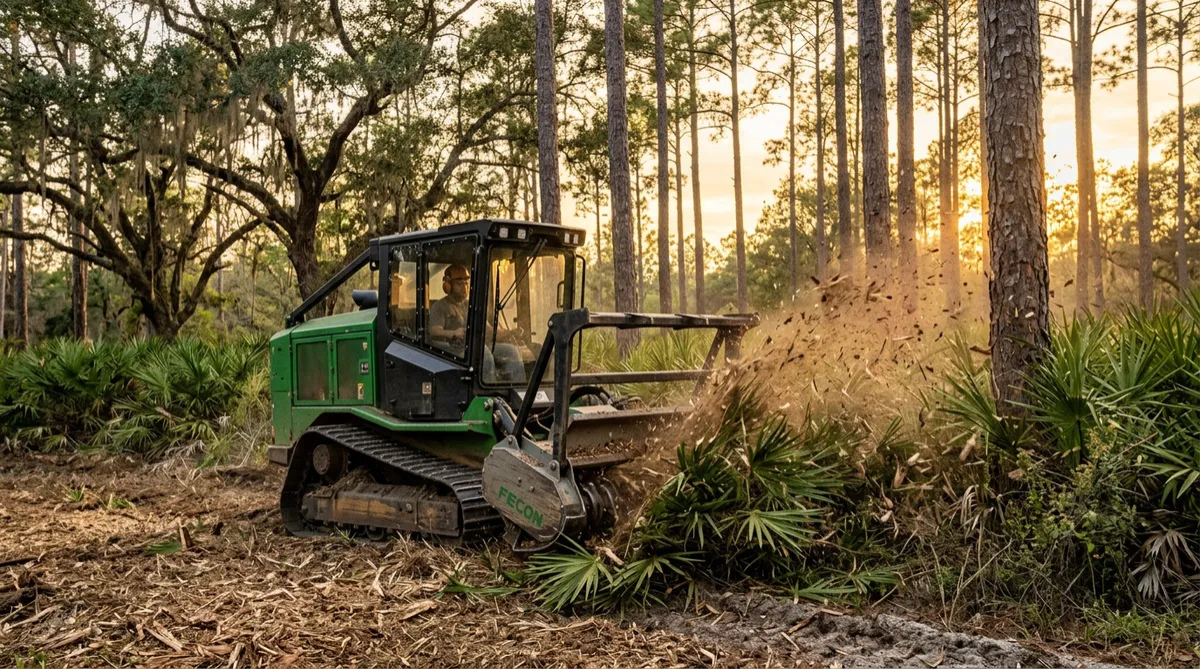
Land Clearing in Interlachen and Putnam County: Preparing Your Lot the Right Way
Preparing land is one of the first big decisions when you plan a home, pasture, driveway, or fire break. In Interlachen and across Putnam County, a lot may combine pine, palmetto, brush, wet areas, and mature trees. Clearing it thoughtfully means more than making space: it means understanding what is on the site, what should stay, where water goes, and what approvals or utility checks are needed before equipment arrives.
A good plan starts with the finished use of the property. The right approach for a house pad may differ from a pasture or a narrow access lane. Before choosing equipment or asking for a price, walk the property, mark the areas to preserve, and identify questions that need an answer from the county, municipality, utility locator, or a qualified environmental professional.

Start with a site walk-through
Walk the whole parcel in daylight, preferably when you can see ground conditions. Note the entrance, likely equipment route, proposed driveway, building area, trees worth protecting, dense vegetation, standing water, slopes, drainage swales, fences, and any signs of buried or overhead utilities. Take photos and sketch simple boundaries. If you are buying or have only recently acquired the property, confirm the lot lines rather than assuming a fence or tree row marks the legal boundary.
Describe the desired result in practical terms: an access route wide enough for construction vehicles, a compact building pad, a cleared homesite with a wooded buffer, or open acreage for grazing. Identify what should remain, including specimen trees and screening vegetation. Share those priorities with the contractor during the site visit, and ask how the work limits will be marked so equipment operators can follow them.
Selective clearing or full clearing?
Selective clearing removes chosen vegetation while keeping designated trees, buffers, or other cover. It can suit a homesite where shade and privacy matter, a driveway corridor through wooded land, or a pasture edge where some windbreak remains useful. It generally requires clear markings and careful machine operation around the plants and roots being retained.
Full clearing removes most vegetation from a defined work area. It may be appropriate for a building pad, broader construction footprint, or a field intended for a new use, but “full” should still mean a precisely described area—not an unmarked sweep across an entire parcel. Agree on boundaries, disposal, stumps, and the expected finish grade before work begins. Clearing is not the same as final grading, excavation, or preparing a foundation; confirm which tasks are included and which require separate planning.
In either case, avoid clearing more ground than the project needs at that stage. Phasing the work can preserve shade and soil cover while plans are finalized, and may reduce the amount of exposed ground that must be managed during rain.
Forestry mulching versus clear-and-haul
Forestry mulching cuts and grinds suitable brush and small vegetation into material distributed on the site. Depending on the machine, vegetation, soil, and desired finish, this can open a work area without hauling every piece of brush away. The resulting mulch may help cover bare ground, but it is not a substitute for a designed erosion-control or drainage plan, and it may not be the finish a building pad or driveway requires.
Traditional clear-and-haul removes brush and debris from the work area for disposal or processing elsewhere. It can be a better fit when the project needs a cleaner surface, when material cannot remain in place, or when larger vegetation and debris need to be handled separately. Stumps, roots, and grading may still need distinct equipment and instructions.
Ask a contractor to explain which method fits your goals and site conditions, what material will remain, what will be removed, and how access, stump treatment, and finish expectations affect the scope. Ask any contractor for proof of insurance and a written description of the work before scheduling. No single method is best for every parcel.
Protect specimen oaks and trees that may be regulated
Mark valuable live oaks and other specimen trees before machinery enters the property. Use visible markers outside the trunk flare, communicate the keep-out area to the crew, and avoid parking, piling debris, or changing grade near roots. A tree can be injured by compacted soil or cut roots even when the trunk is untouched. If the tree’s condition or safe working distance is uncertain, get advice from a qualified tree professional.
Do not assume every tree can be removed simply because it stands on private land. Protection can depend on where the property lies and the applicable local requirements. Confirm county and municipal tree-removal, land-clearing, and permit rules with the relevant authorities before cutting. Ask specifically about protected trees and any review process that may apply to your parcel. This is especially important if the project is near a water body, wetland, or other environmentally sensitive area.

Drainage, erosion, wetlands, and floodplains
Before clearing, observe where stormwater naturally moves and where it collects. Keep existing drainage paths in mind when laying out a pad, driveway, or cleared area; do not direct runoff onto a neighboring property or block a swale. Bare, disturbed soil can erode during heavy rain. Ask how the work will limit exposed ground and what stabilization or erosion-control measures are needed for the project.
Use extra caution on property near the St. Johns River, Crescent Lake, Lake Interlachen, or other water features. Proximity alone does not tell you whether land is wetland, floodplain, or subject to special review. Check the site and proposed work with the appropriate county or municipal offices and qualified environmental professionals before clearing or filling. Do not drain, fill, or push material into wet areas based on a visual guess. If the mapped conditions or boundaries are unclear, pause and obtain site-specific guidance.
Permits, burning, and utility locating
Requirements can vary with the parcel, the scope, and the jurisdiction. Confirm local county and municipal permit rules before starting, including whether land clearing, tree removal, grading, driveway work, or work near water needs review or approval. Confirm current local and state burn rules with the proper authorities before burning any debris. Do not rely on a neighbor’s past experience as proof that a burn or clearing activity is allowed today.
Call Florida 811 before digging. Locate underground utilities before excavation, stump removal, trenching, or other ground disturbance, and follow the locator’s instructions. Also identify overhead lines and plan equipment movement around them. A contractor’s site visit does not replace permit checks or utility locating.
Plan for wet and storm seasons
Florida’s wet season can bring frequent heavy rain, and hurricane season calls for attention to weather forecasts and site conditions. Timing depends on the project and the ground—not just the calendar. Wet soil may rut under heavy equipment; freshly cleared ground may need prompt stabilization before rain. Ask how the schedule could change if conditions become unsafe or the site cannot support machinery without damage.
Keep the work area, access route, and any temporary material piles organized so runoff and debris can be managed. Before a tropical system or major storm, follow local guidance for securing the site and handling loose material. Leave a buffer around drainage features and avoid creating an open, bare expanse unless it is needed for the next construction phase.
Match clearing to the planned use
Driveways and access
Mark the alignment, entrance, turning needs, and connection to the future work area. Check drainage crossings, sight lines, and the surface requirements for the vehicles that will use it. Clearing only the corridor first may preserve the rest of the parcel while access plans are confirmed.
Building pads
Use the building footprint and site plan to establish the work boundary. Clearing does not automatically make ground suitable for a foundation. Coordinate later grading, soils evaluation, drainage, and construction requirements with the appropriate professionals.
Pasture and fire breaks
For pasture, identify which trees or buffers should remain and how the cleared area will be finished for its intended use. For a fire break, plan a continuous, maintainable strip and ask local fire or land-management authorities for site-specific guidance. A mulched strip is not automatically a fire break that meets every need; the vegetation, width, maintenance, and neighboring conditions matter.
Local planning around Putnam County
Interlachen properties may be close to Lake Interlachen or Crescent Lake, while other projects may be nearer the St. Johns River. In Palatka, Ravine Gardens State Park is a familiar local landmark; the Rodman and Cross Florida Greenway area and Welaka State Forest are also recognizable features of the wider region. These places help orient a local conversation, but a landmark is not a substitute for checking a specific parcel’s boundaries, drainage, or environmental status.
For work in Palatka, Green Cove Springs, or Flagler County, verify which local authority has jurisdiction over the property and the proposed activity. Do not assume Putnam County requirements apply elsewhere. A contractor familiar with the general area can still need you to confirm site-specific approvals, access constraints, or utility information before work begins.
A straightforward preparation checklist
- Define the finished use and mark the limits of work.
- Identify trees, buffers, drainage paths, wet areas, fences, and utilities.
- Confirm local permit, protected-tree, and burn requirements.
- Call Florida 811 before ground disturbance.
- Choose mulching or clear-and-haul based on the desired result and site.
- Agree in writing on debris, stumps, grading, access, and preservation.
- Plan the schedule around soil conditions, rain, and storm forecasts.
Frequently Asked Questions
1. Do I need a permit to clear my lot in Putnam County?
It depends on the parcel and the work. Confirm current county and municipal requirements, including tree, grading, driveway, and environmentally sensitive area rules, with the relevant authorities before starting.
2. Is forestry mulching the right choice for every property?
No. Mulching can be useful when processed vegetation may remain on site, while clear-and-haul may better fit a cleaner finish or project that requires debris removal. Compare the proposed result with the next step in your project.
3. Can mature live oaks be saved during clearing?
Often a plan can preserve selected trees, but their survival depends on condition and protection during work. Mark keep areas, protect root zones from equipment and grade changes, and seek professional advice where needed.
4. What should I do before stump removal or excavation?
Call Florida 811 before digging, confirm local approvals, and identify the exact work area. Discuss underground and overhead utilities, access, drainage, and how removed material will be handled.
5. When is the best time to clear land in Northeast Florida?
There is no single best date for every lot. Consider soil firmness, wet-season rain, the project sequence, and storm forecasts, then schedule with a contractor who can adjust to changing site conditions.
Plan your next step
For help planning land clearing in Interlachen, Putnam County, and nearby communities, contact Arborman Tree Services in East Palatka, FL at +1 904-830-5399 or visit arbormantreeco.com. Discuss the intended use, areas to preserve, and site questions before work begins.
Website built by astreetgarage.com
