Land Clearing in North Florida: A Practical Plan Before the First Pass
Land Clearing in North Florida: A Practical Plan Before the First Pass
Opening a view, preparing a homesite, making room for a driveway or reclaiming a pasture can start with the same question: what should stay, and what needs to go? Land clearing is not simply cutting everything down. A good project creates usable space while protecting the trees, soil, drainage and neighboring property that matter to you.
For property owners in Putnam County and nearby parts of Volusia and Flagler counties, the right approach depends on the land itself. A wooded parcel near the St. Johns River is different from an upland homesite outside Interlachen, and both differ from a small driveway corridor in East Palatka. Planning first can help prevent avoidable damage, delays and cleanup costs.

Start with the purpose of the clearing
Be specific about the result you need. A home or outbuilding site may call for a defined building envelope, access for equipment and room for drainage features. A driveway project may need a narrow, carefully marked corridor rather than broad clearing. Pasture preparation might require removing brush and selected small trees while retaining shade trees, windbreaks or useful boundary vegetation.
Fire breaks and defensible areas have different goals again: create a maintained, accessible strip and manage fuel without sending debris or runoff onto adjoining land. If your plans include a future home, septic system, well, pond or road, coordinate the clearing footprint with the relevant design and permitting work. Clearing too early or too widely can remove trees you later want, disturb soils, or leave the site harder to manage.
Forestry mulching or traditional clearing and hauling?
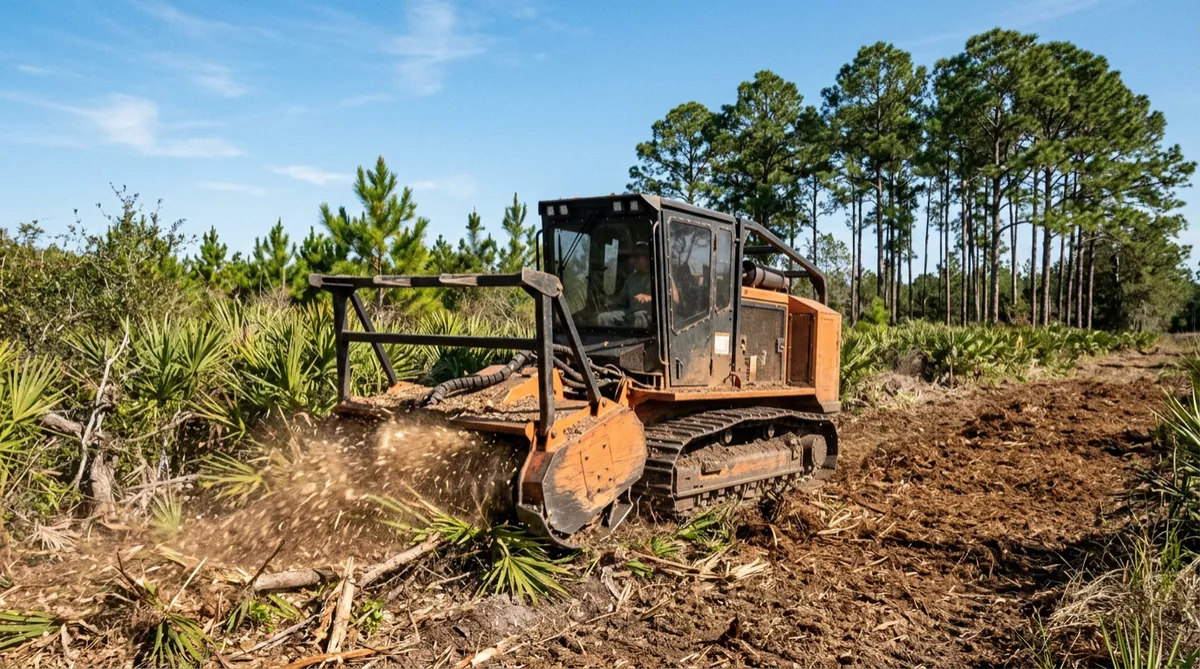
Forestry mulching uses specialized equipment to cut and process vegetation on site, leaving a layer of shredded material over the soil. It can be a practical choice for brush, palmetto and smaller trees when the goal is to open an area without hauling every piece away. The retained mulch can help cover bare ground, but it is not a substitute for a drainage or erosion plan, and it may not suit every finish or future use.
Traditional clearing may involve cutting, piling, loading, hauling, stump work or other equipment. It can be preferable where the owner needs a cleaner surface, larger trees or stumps removed, or debris transported off site. Some projects combine methods: mulch brush in one area, selectively remove trees in another, and haul material where piles or residue would interfere with construction.
Neither approach is automatically cheaper or better. Equipment access, vegetation size and density, wet ground, haul distance, disposal requirements and the desired finished grade all affect the work. Ask the contractor to describe what will remain on site, what will be removed, whether stumps are included, and how the final surface will look.

Walk the property and mark what matters
A site assessment should look beyond the trees. Identify property boundaries, access points, slopes, low areas, ditches, culverts, nearby structures, fences and overhead or underground utilities. Note where water naturally flows and where the ground stays wet. Near the St. Johns River, Crescent Lake or other water features, changing vegetation or grade without a plan can affect drainage and sensitive areas.
Mark the intended clearing limits clearly and point out trees to retain. Include heritage or protected trees, healthy shade trees, specimen pines, screening vegetation and any tree that helps stabilize a bank or property edge. If boundaries are uncertain, do not rely on a casual visual guess; confirm the surveyed line before equipment approaches it.
Before clearing, call 811 to have underground utilities located, and allow the required response time before digging or stump work. Tell the crew about private lines and site features that public utility marking may not cover, such as irrigation, a well line, septic components, landscape lighting or a private power connection. Keep people, pets and vehicles outside the active work area.
Check permits, protected resources and wetlands
Tree and land-clearing requirements can depend on the property, project and local jurisdiction. Before work begins, confirm with the appropriate county whether permits, tree protections, development approvals or other reviews apply. Do not assume that a rule for one parcel or municipality automatically applies to another. Putnam County property owners should verify requirements with the county; owners in Volusia or Flagler should check with the county and local government that serves their address.
Wetlands and surface waters deserve special care. If a parcel may contain wetlands, flood-prone ground, drainage connections or regulated surface waters, pause and ask the appropriate authorities about review before disturbing soil or vegetation. The St. Johns River Water Management District may have a role depending on the site and activity; confirm directly rather than treating a map impression or a contractor's assumption as approval.
Gopher tortoises and their burrows are protected. If a tortoise or burrow is present, do not disturb it or try to move it yourself. Florida Fish and Wildlife Conservation Commission permitting requirements apply to activities that affect tortoises or burrows; consult the agency and obtain required authorization before proceeding. A responsible contractor should be willing to stop and help you arrange the right next step if protected wildlife is encountered.
Plan for drainage, soil and debris
Clearing changes how rain reaches the ground. Keep natural drainage paths in mind, avoid pushing soil into ditches or neighboring property, and consider how bare areas will be stabilized. On sloping ground, along a drainage route or where heavy equipment could rut wet soil, a project may need erosion and sediment controls. Ask who is responsible for them and how disturbed areas will be left at completion.
Decide in advance what happens to woody debris. Mulched material can remain spread over suitable areas; larger brush may be chipped, piled for later handling or hauled away. Burning is not a default disposal plan: local restrictions, burn authorizations, weather and fire conditions can apply. Check current county and state requirements before any burn, and never assume a pile can be burned simply because it is on private land.
Choose a season and sequence the work
Florida's drier months can offer firmer access on many properties, while wet-season rain can make low ground soft and increase rutting and runoff concerns. Weather varies from year to year, so the calendar alone does not determine whether a site is ready. A contractor should assess actual soil conditions and reschedule when equipment could cause unnecessary damage.
Coordinate clearing with surveying, utility marking, permitting and construction. If the land is near a home or a public road, discuss access, traffic, noise, dust and protection of driveways or pavement. Around communities such as Palatka and East Palatka, and near landmarks like Ravine Gardens State Park, the St. Johns River setting makes thoughtful drainage and retained vegetation especially important. For projects farther south or east, the same planning helps protect property near Daytona International Speedway, Stetson University in DeLand, Gamble Rogers Memorial State Recreation Area and the Flagler Beach Pier.
Understand what drives project cost
There is no reliable one-size-fits-all price for land clearing. The work area, vegetation type and density, tree diameter, access, ground conditions, slope, proximity to structures, amount of stump removal, hauling distance and disposal method can all change the scope. Permitting, wildlife review, erosion controls, utility protection and finish grading may add separate tasks.
Ask for a written scope that defines the boundary, equipment approach, trees to retain, debris destination, stump treatment, cleanup and any exclusions. If a quote assumes easy access or dry conditions, ask what happens if those assumptions prove wrong. Comparing clearly described scopes is more useful than comparing a single total without knowing what each contractor includes.
How to choose a land-clearing contractor
Look for a contractor who is appropriately licensed for the work where required and carries current liability insurance and workers' compensation coverage as applicable. Ask for proof of coverage, a written estimate and a clear description of the work. Discuss equipment experience, utility marking, wildlife and wetland concerns, tree protection, erosion control and debris handling before signing.
Be cautious if someone proposes clearing first and checking permits later, promises that every tree can be removed without review, or cannot explain where debris will go. A trustworthy professional should welcome questions, identify assumptions and explain when a project needs input from the county, a surveyor, an engineer or a permitting agency.
Frequently Asked Questions
Does land clearing always mean removing every tree?
No. Many projects are selective. You can define a clearing boundary and identify trees or vegetation to retain for shade, screening, habitat, erosion control or appearance.
Is forestry mulching right for every property?
No. It works well for some brush and vegetation, but larger trees, stump removal, a construction-ready surface, hauling needs or sensitive ground may call for a different method or a combination of methods.
Do I need a permit before clearing?
Possibly. Requirements depend on the property and proposed work. Confirm with the county and any other relevant authority before disturbing trees, wetlands or soil; do not rely on a general assumption about local rules.
What should I do if I find a gopher tortoise burrow?
Stop work near it and do not disturb or move the tortoise. Contact the Florida Fish and Wildlife Conservation Commission or a qualified professional to determine the required permitting and next steps before work resumes.
How do I get ready for a contractor's visit?
Share a survey or clear boundary information if available, describe your intended use, mark trees to keep, identify private utilities and septic or well features, and list any known drainage or wildlife concerns. Call 811 before digging or stump work.
Plan your North Florida clearing project
Whether you are preparing a homesite in Putnam County, opening a driveway near Interlachen, improving pasture or planning a property in Volusia or Flagler County, start with a clear scope and a site-specific review. Arborman Tree Services can discuss your goals and the practical options for the land. Call (904) 830-5399 or visit arbormantreeco.com to get the conversation started.
Website built by astreetgarage.com
