Tree Health in St. Augustine: A Florida Homeowner Guide
Trees are part of daily life in Northeast Florida: they shade homes, frame familiar streets and parks, and soften the effects of heat and wind. When a live oak thins, a pine shows fresh boring dust, or a palm declines, it is natural to wonder whether disease is involved. A change in appearance is a clue, not a diagnosis. The same symptom can follow drought, flooding, root disturbance, pests, disease, or normal seasonal change. Careful observation and a qualified assessment can help you choose a sensible next step.

1. Read the whole tree, not one symptom
Note what changed, where, and how quickly. Canopy thinning, dead branch tips, early leaf drop, unusual color, smaller leaves, or one-sided dieback can signal stress. Look for fresh sawdust-like frass, holes, oozing, fungal growth, cracks, cavities, a new lean, heaving soil, or damaged roots. No single sign confirms a cause.
Compare affected and healthy parts of the tree and nearby trees of the same species. Record weather, irrigation, construction, trenching, paving, grade changes, and chemical applications; dated photographs can show whether symptoms are spreading. Do not cut bark, pull suspect limbs, or disturb fungal growth. Some seasonal leaf loss or minor twig dieback may be normal, while a green crown does not rule out root or structural problems. Consider what a failure could reach.
2. Pests and diseases found in Florida landscapes
Southern pine beetle and Ips engraver beetles can attack pines, particularly after stress. Boring dust, resin flow, entry holes, fading crowns, or bark changes warrant a closer look, but are not diagnostic on their own. An arborist can assess the pattern and decide whether further testing or action is appropriate.
Persistently wet soil can contribute to root decline. Ganoderma butt rot may produce a shelf-like conk near the base of a palm or hardwood; the conk does not reveal how much trunk is compromised. Keep people clear of an unstable-looking tree and arrange an on-site assessment.
Oak wilt should not be overstated as a leading Florida threat. Laurel wilt affects redbay and related plants, including avocado, and is not a general explanation for declining oaks. Lethal bronzing affects susceptible palms; potassium or manganese deficiencies can also cause palm symptoms, so diagnosis matters.
Spanish moss is an air plant, not a parasite; heavy growth may add weight to weak branches but does not prove disease. Mistletoe is parasitic and may contribute to stress when widespread. A professional can identify what is present and whether action is warranted.

3. Weather, soil, roots, and everyday stress
Humid, storm-prone weather can combine with sandy soil, drought, and sudden heavy rain to stress roots. Sandy soils drain quickly; flooding reduces oxygen around roots, and symptoms may lag behind the weather that triggered them.
Trenching, grading, soil fill, vehicle compaction, and pavement can damage roots or change drainage. Roots extend beyond the trunk flare, so nearby work matters. Protect the root zone and discuss construction plans with a tree professional before work begins.
Mulch conserves moisture when applied in a broad, moderate layer, but keep the trunk flare visible and avoid “volcano mulching.” Irrigate for site conditions rather than keeping soil constantly wet or watering shallowly too often. Coastal salt spray and storm damage can add further stress.
4. What a tree health assessment can establish
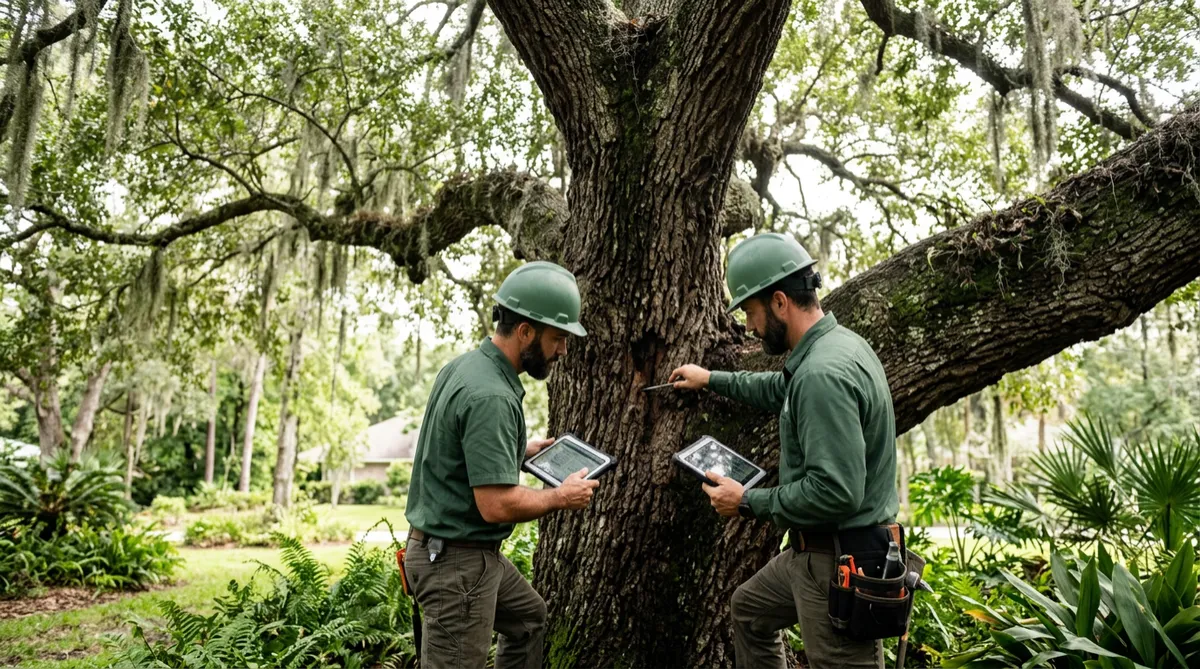
A useful assessment starts with the site and the tree’s history, not a one-size-fits-all treatment. An ISA-certified arborist can review the species, age or size, canopy pattern, trunk, branch unions, root flare, soil surface, nearby drainage, recent work, and the target area around the tree. The arborist may inspect several trees, compare healthy and declining specimens, and ask when symptoms first appeared. If a problem is uncertain, the next step could include lab testing or consultation with UF/IFAS Extension rather than guessing.
The findings should explain what is known, what remains uncertain, and how urgent the situation is. A tree health assessment may recommend monitoring, correcting a site stress, pruning dead or hazardous branches, or obtaining a more focused evaluation. For structural concerns, a risk assessment considers the likelihood of failure and the consequences for people or property. A visual inspection has limits: internal defects and root conditions are not always visible, and no assessment can guarantee that a tree will never fail.
County UF/IFAS Extension offices serve St. Johns, Putnam, Flagler, and Volusia counties and can be a useful source of local plant-health information. Extension resources can help with general identification and education; they do not replace an on-site evaluation where a tree presents a safety concern or a treatment decision depends on the actual site.
5. Matching treatment to the cause
Good care addresses the conditions behind a problem where possible. Soil care may include protecting roots from compaction, improving the growing area, or adjusting irrigation and drainage. Properly placed mulch can support soil moisture, while keeping it away from the trunk helps reduce avoidable problems. Pruning may remove dead, broken, crossing, or poorly attached branches when there is a clear reason and the work can be performed safely. Pruning is not a cure for every disease, and excessive cutting can add stress.
Some pests or diseases may be managed with targeted measures, but the correct option depends on the confirmed cause, tree species, timing, and extent of damage. Trunk injections are appropriate only in selected situations and should be prescribed and applied by qualified professionals; they are not a general-purpose remedy. Fungicides or insecticides cannot restore roots that have been lost, reverse advanced decay, or correct poor drainage. Ask what the treatment is meant to do, what evidence supports it, what follow-up is needed, and what limitations remain.
Removal may be the safest recommendation if a tree is dead, structurally unsound, severely compromised, or in a location where failure could cause unacceptable harm. A declining tree is not automatically a removal candidate, and an attractive canopy is not proof of safety. When removal is proposed, ask the assessor to explain the specific condition, the target exposure, and whether practical alternatives exist. If a tree is leaning suddenly, has a lifted root plate, or has a large broken limb, keep clear and arrange prompt professional attention.
6. Prevention and local tree health across Northeast Florida
Prevention begins before symptoms show. Select trees suited to the site and leave adequate room for mature roots and crowns. Protect root zones during construction, avoid changes in grade near established trees, and direct irrigation to the root area without keeping it waterlogged. Mulch in a broad, restrained layer, keep the trunk flare visible, and prune for a clear purpose rather than topping or routinely removing too much live foliage. After storms, check from the ground for hanging limbs, fresh cracks, and soil movement; do not climb or approach damaged trees.
Local conditions vary from inland sandy soils to coastal exposure. Around St. Augustine and St. Johns County, live oaks and pines share a landscape with landmarks such as Castillo de San Marcos, the Bridge of Lions, the Lightner Museum, Anastasia State Park, and the St. Augustine Lighthouse. The St. Johns River corridor can bring different moisture conditions from a coastal property, while salt spray near the shore can stress sensitive foliage. Tree health care should account for those site differences rather than treating every neighborhood alike.
In Green Cove Springs, Spring Park is a familiar reminder of the area’s connection to water; changing wetness and drainage still matter in residential root zones. In Putnam County, Lake Interlachen and Ravine Gardens State Park frame landscapes where drought-then-flood cycles and sandy soils can affect trees. Flagler County’s Washington Oaks Gardens State Park and Flagler Beach Pier sit within a coastal setting where wind and salt spray can add stress. In Volusia County, Blue Spring State Park and Daytona International Speedway are well-known points of reference amid landscapes that include pines, palms, and oaks. These places are not diagnoses; they illustrate how varied local exposure and soil conditions can be.
Arborman Tree Services works with homeowners and property managers in St. Augustine, Green Cove Springs, Interlachen, Volusia County, Flagler County, St. Johns County, and Putnam County. Across these service areas, live oaks, laurel oaks, pines, and palms may face humidity, sandy soils, periods of drought followed by heavy rain, storm stress, root compaction from construction, and coastal salt exposure. A site-specific assessment can help separate normal variation from a problem that needs attention.
Frequently Asked Questions
Does Spanish moss harm a tree?
Spanish moss is an air plant and does not draw food from the tree. Heavy growth may add weight to already weakened branches, but it is not by itself proof of disease. Look at the tree’s condition and structure as a whole.
Can I identify a tree disease from a photo?
A photo can help document symptoms, but it rarely shows the roots, site conditions, or full pattern needed for a firm diagnosis. Several problems can produce similar leaf or bark changes. For treatment or safety decisions, arrange an on-site assessment or consult UF/IFAS Extension resources.
Are mushrooms at a tree’s base always dangerous?
No, a mushroom alone does not identify a specific decay problem or tell you how strong the trunk is. A hard conk near the base can be consistent with Ganoderma butt rot and deserves professional attention. Keep away from a tree that appears unstable until it has been assessed.
Should I fertilize a declining palm?
Not before confirming the likely cause. Palm nutrient deficiencies, including potassium and manganese, can resemble other health problems, and excessive or poorly chosen fertilizer can add stress. A professional or UF/IFAS Extension resource can help guide diagnosis and appropriate care.
When should a tree be removed?
Removal may be warranted when a tree is dead, has serious structural defects, or poses an unacceptable risk that cannot be reasonably managed. Leaning, root heaving, major cracks, or large broken branches deserve prompt attention, but one symptom alone does not settle the decision. An on-site risk assessment can explain the findings and options.
A measured next step
Tree symptoms are worth noticing, but they do not always mean a tree is diseased or beyond help. Photograph changes, note recent weather and site work, and keep people clear of any tree that looks unstable. For a careful, site-specific opinion, contact Arborman Tree Services at (904) 830-5399 or visit arbormantreeco.com to request an estimate or tree health assessment.
Website built by astreetgarage.com

