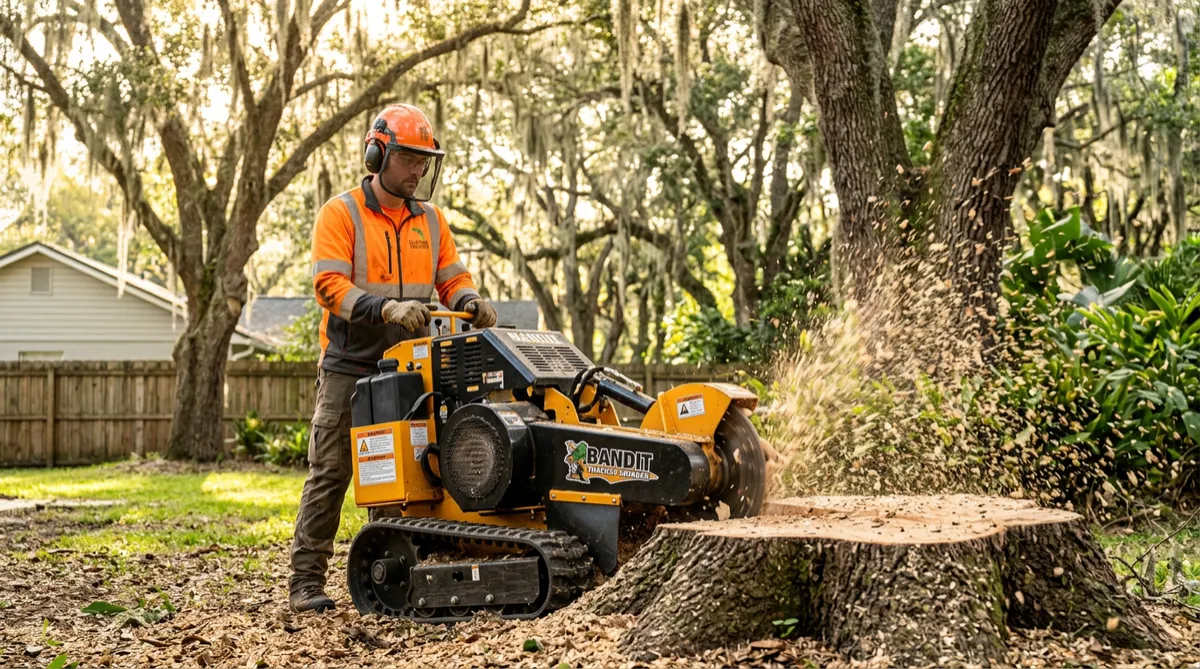
Stump Grinding & Removal in St. Augustine and St. Johns County: What Homeowners Should Know
A cut-down tree may be gone, but its stump can keep getting in the way. It can interrupt mowing, limit where you plant, and leave an awkward obstacle in an otherwise usable yard. In St. Augustine and across St. Johns County, choosing what to do with a stump means weighing the site, the roots, and what you want the space to become—not just how the stump looks today.
Stump grinding and full stump removal are different services. Knowing how each works, what happens to the wood chips, and how to plan for underground utilities can help you make a practical choice for your property.

How stump grinding works
A stump grinder uses a rotating cutting wheel to chip away the stump in layers. The operator works across the wood and gradually lowers the cutting head, turning the stump and nearby surface roots into a mixture of wood fragments and soil. The equipment and approach vary with stump size, access, the tree species, and the surrounding landscape.
Grinding is generally a way to deal with the visible stump and a portion of the main root crown without excavating the entire root system. Large roots may extend well beyond the stump, often spreading through the upper soil. Grinding does not pull out every root, and it does not make the remaining roots disappear immediately. Roots left below ground break down over time.
How deep to grind depends on the intended use of the area. If the goal is to remove a tripping or mowing obstacle and restore the lawn, the work may only need to extend several inches below surrounding grade. A future planting plan, hardscape, or other use may call for a different depth or a wider work area. Discuss the plan before work begins: a depth suitable for grass may not provide enough prepared soil for a new tree or construction project.
Grinding versus full stump removal
With grinding, the stump is reduced in place and the larger underground roots remain. This is often a practical choice when the aim is to reclaim the surface, keep excavation limited, and avoid disturbing a broad section of yard. It can be especially useful where mature trees, established beds, fences, or nearby improvements make extensive digging undesirable.
Full removal generally means digging or pulling out the stump and a substantial portion of the root mass. That can leave a larger excavation and may be appropriate when the space must be cleared for a specific installation, when a stump’s roots conflict with planned work, or when the project calls for removing more of the root crown. The method can disturb more soil and nearby landscaping, and the exact scope depends on the site and equipment access.
Neither option removes every root that has spread through the yard. Consider the next use of the ground, the stump’s size and condition, access for machinery, and how much surrounding soil can be disturbed. If you are preparing for a patio, a new tree, or another substantial improvement, coordinate the stump work with the contractor responsible for that project so the required clearance is clear in advance.
Root flares, sandy soil, and local landscapes
The base of a tree often widens where the trunk meets the roots. Those buttress-like roots are part of the root flare, and they can make the stump broader and less uniform than the cut trunk suggests. Some surface roots may also radiate outward and cross the lawn. A plan focused only on the trunk can leave raised wood outside the immediate stump area, so ask how visible surface roots will be handled and what is excluded from the work area.
Many St. Augustine and St. Johns County properties have sandy soils, though conditions vary from lot to lot. Sandy ground can drain differently from compacted or organic soils, and the site’s moisture, grading, and nearby plantings affect how chips and backfill settle. Roots can spread laterally in search of water and oxygen, so the visible stump does not show the full extent of a tree’s root system. Avoid assuming that removing one stump means all nearby roots are gone.
Stump work in older areas with mature live oaks, including St. Augustine’s historic district, calls for care around established root zones. The city’s varied surroundings include the Castillo de San Marcos, Bridge of Lions, St. Augustine Lighthouse, Fountain of Youth Archaeological Park, and Anastasia State Park. These familiar landmarks sit within a mix of historic streets and coastal landscapes, so assess each private yard on its own.
What happens to the wood chips?
Grinding creates a loose pile of chips mixed with fine wood and soil. Ask whether the service includes removing the chips, leaving them on site, or using some of the material to fill the depression. The right choice depends on your plans. Leaving chips nearby can make it easier to spread them in a garden bed or take them away later, while hauling them off may suit a lawn restoration project better.
Fresh chips are not the same as finished topsoil. A thick layer of woody material mixed into the planting zone can affect how the surface settles and may make it harder for grass seed to establish. If the goal is turf, discuss whether the area should be cleared of excess chips and topped with suitable soil. If you reuse the chips as mulch, keep them on the surface around appropriate plantings rather than mixing a deep quantity into the soil where new roots will grow.

Utility locating and safe preparation
Before any digging, grinding, or other ground-disturbing work, contact Florida 811 to request utility locating and follow its instructions about timing, markings, and the work area. Do not rely on memory, old plans, or visible meters to determine where buried lines run. A locate request helps identify underground utilities in the planned work zone; it does not necessarily identify every private line on a property, such as some irrigation, lighting, or other owner-installed systems. Point out known private lines and ask the appropriate provider how those should be located.
Before the crew arrives, clear movable items from the access route and the immediate work area. Mention irrigation heads, low-voltage lighting, fences, retaining walls, planting beds, and any known underground services. Confirm access width, where equipment can travel, what protection is planned for nearby surfaces, and whether the work area will be roped off. Keep children and pets away from operating equipment and flying chips.
Cost factors to discuss
Stump-grinding costs are shaped by the work rather than by a single standard price. Relevant factors may include stump diameter and height, wood hardness, how many stumps are involved, the amount of surface-root grinding requested, the target depth, and whether chips or debris need to be hauled away. Access also matters: a narrow gate, steep or soft ground, nearby structures, or landscaping that needs protection can change the time and equipment required.
When comparing estimates, make sure they describe the same scope. Ask whether the quote covers just the stump or visible surface roots too, how far below grade the work will go, what will happen to the chips, whether fill material or lawn repair is included, and how the area will be left. For any tree-service work, homeowners should ask the company to provide proof of insurance and clarify responsibility for existing irrigation, utilities, and landscape features before work starts.
Aftercare: restoring the area or planting again
Once grinding is complete, the ground may settle as remaining roots decay and loose material shifts. For lawn restoration, remove excess chips, fill the depression with suitable soil, and level the surface without covering nearby tree trunks or burying existing plants. Choose grass seed or sod suited to the site and season, then follow watering guidance for establishment. Keep foot traffic and mowing gentle while the new turf takes hold.
If you plan to plant another tree, do not assume the old stump’s footprint is ready for a replacement. Remaining wood can settle and decompose, and planting directly into a deep chip-filled cavity may create an unstable or nutrient-imbalanced growing area. Ask a qualified local tree professional or nursery about a suitable planting location, species, spacing, and soil preparation. A nearby location outside the old root crown may be preferable, depending on the yard and the new tree’s mature size.
Timing and storm-damaged stumps
Stump work can be planned whenever site conditions, access, and the intended restoration make sense. Rain, saturated ground, and soft lawns may affect equipment access and the chance of rutting, while dry conditions can make cleanup and grading easier. In summer, consider how heat and watering needs affect newly seeded or sodded areas. Before scheduling, ask how weather could affect the work and the lawn repair that follows.
After a storm, a fallen or removed tree can leave a stump mixed with broken limbs, exposed roots, or other debris. Separate debris removal from stump grinding when discussing the scope: clearing branches, hauling logs, assessing a damaged tree, and grinding a stump are distinct tasks. Do not burn a stump or attempt to cut into it without understanding the risks, nearby utilities, and local requirements. If the tree or stump is unstable, near a structure, or tangled with overhead or buried services, keep clear and arrange an appropriate professional assessment.
Hurricane season is a good reason to keep the yard’s cleanup plan in mind, but it does not mean every stump must be removed immediately. If a stump is blocking access, creating a hazard, or complicating planned repairs, make that clear when asking for an assessment. For properties in St. Augustine, St. Johns County, and nearby Flagler and Putnam counties, a site-specific plan is more useful than assuming every yard has the same soil, access, or root conditions.
Frequently Asked Questions
1. Does stump grinding remove the roots?
No. Grinding reduces the stump and usually part of the root crown, while many roots remain underground and decay naturally over time. Full excavation can remove more of the root mass, but roots extending farther into the yard are not all removed.
2. How deep should a stump be ground?
It depends on the intended use. A lawn repair may need a different depth from a new planting or construction project. Discuss the finished grade and what will occupy the space before work begins, and have the scope specify the target depth.
3. Can I plant a new tree where the stump was?
Sometimes, but planting directly into the old stump cavity may be difficult because wood and chips settle as they decompose. A nearby site with adequate room and prepared soil may work better. Choose the location and tree with advice suited to the property.
4. Should I keep the wood chips?
You can reuse some chips as surface mulch if they suit your landscape, or ask about removal. For reseeding or sod, excess chips generally need to be cleared and the area prepared with appropriate soil so the lawn can establish.
5. Do I need to contact Florida 811 before stump work?
Contact Florida 811 before digging or other ground-disturbing work and follow its locate-request instructions. Also disclose known private utilities, such as irrigation or landscape lighting, because those may require separate locating.
Plan your next step
If a stump is taking up useful space or complicating your landscape plans, get the site assessed and ask what the proposed work includes—from target depth and surface roots to chip cleanup and aftercare. Arborman Tree Services serves the St. Augustine area from East Palatka, Florida. Call +1 904-830-5399 or visit arbormantreeco.com to discuss your stump-grinding or removal project.
Website built by astreetgarage.com
