Tree Removal in North Florida: Signs, Safety & Planning
Tree Removal in North Florida: Protecting Your Property and Planning the Right Next Step
A mature tree can shade a home, frame a neighborhood, and make an outdoor space feel rooted in place. But when a tree is dead, structurally failing, or positioned to cause serious damage, removal may be the safest and most responsible option. For homeowners and property managers, the decision is rarely as simple as “keep it” or “cut it down”: tree health, targets, weather exposure, access, local rules, and the right work plan all matter.
Across St. Augustine, Green Cove Springs, Interlachen, and communities in Volusia, Flagler, St. Johns, and Putnam counties, local trees face coastal conditions, sandy or saturated soils, strong summer storms, and occasional hurricane-force winds. A careful assessment helps distinguish a manageable concern from a hazard that warrants prompt action—and helps protect people, structures, and the valuable trees that should remain.

When Is Tree Removal the Right Call?
Removal is generally considered when a tree cannot be made reasonably safe through pruning or other care, or when its location and condition create an unacceptable risk. A dead tree with brittle limbs over a home, for example, is different from a healthy tree with a low branch that can be pruned. A qualified tree professional can explain what can be preserved, what needs attention, and why removal may be recommended.
Some situations are urgent: a tree or major limb has fallen, the trunk has split, roots have lifted suddenly, or a tree is leaning toward an occupied building after a storm. Keep people away from the area and contact emergency services if there is immediate danger, a blocked public road, or a downed tree involving electrical wires. Never approach, touch, or attempt to move a tree or branch tangled with power lines; report it to the utility and let trained responders handle the hazard.
Other decisions allow time for a thoughtful review. Construction, repeated limb failure, root damage to important infrastructure, or a declining tree that cannot be stabilized may make removal the practical choice. On a property near Castillo de San Marcos or the Bridge of Lions in St. Augustine, for instance, a mature canopy can be part of the setting; preserving sound trees while addressing a specific hazard helps balance safety with neighborhood character. The goal is not to remove every imperfect tree, but to make an informed decision based on condition and risk.
Warning Signs Homeowners and Managers Should Notice
Walk the property from a safe distance and look for changes, especially after heavy rain or wind. No single sign proves that a tree must come down, but several findings together can justify a prompt professional inspection:
- Major cracks or splits: A deep crack in the trunk or at a large branch union may indicate that wood is separating under load.
- Large dead limbs or a thinning crown: Extensive dieback, hanging branches, or a sudden loss of foliage can point to serious decline or damage.
- Root-plate movement: Freshly lifted soil, exposed roots, or a new lean after a storm can signal instability. Do not try to push or brace a large tree yourself.
- Trunk decay or cavities: Fungi, soft or missing wood, and cavities can be warning signs, although an arborist must assess how they affect the tree’s strength.
- Repeated branch failure: Several failures in a short period, particularly over a roof, walkway, parking area, or play space, call for expert evaluation.
- Contact with structures or utilities: A tree that interferes with a building or line needs a safe, site-specific plan; utility-related work should be left to authorized professionals.
Consider what could be struck if a limb or trunk failed: a home, vehicle, pool, fence, sidewalk, neighboring property, or a regularly used outdoor area. Property managers should also note access routes and shared spaces, and document visible changes after storms. Photos can help communicate when a condition appeared, but they cannot replace an on-site assessment.
North Florida Species and Site Conditions Matter
North Florida properties include live oaks, laurel oaks, southern pines, sweetgum, and palms. Each has different growth and stress patterns: a broad live-oak canopy, a declining laurel oak, a damaged pine, or a palm may call for a different assessment. Species alone does not determine whether removal is needed.
Soil saturation, coastal wind, salt exposure, construction disturbance, and past pruning all matter. An arborist should assess the whole tree and site. In St. Augustine, historic surroundings and tight access can shape a work plan; near Spring Park in Green Cove Springs, established trees contribute to the riverfront setting. Ravine Gardens State Park in Palatka, Putnam County, Washington Oaks Gardens State Park and Flagler Beach in Flagler County, and Blue Spring State Park and Daytona Beach in Volusia County reflect the region’s variety. The St. Augustine Lighthouse is a familiar St. Johns County landmark. Each private-property decision still depends on its specific tree and risks.
Permits, Property Lines, and Local Requirements
Before scheduling removal, check whether the tree, property, or proposed work is subject to local requirements. Rules can vary among municipalities and counties and may depend on the tree’s location, size, condition, protected status, zoning, historic or environmental overlays, and whether the property is part of a development or association. A tree near a public right-of-way, water, or a designated district may require additional review. Do not assume that a tree is exempt simply because it is on private land, or that a contractor’s recommendation substitutes for approval.
Contact the relevant city or county office and ask what applies to the address and the specific tree. This is particularly important when work is planned in St. Augustine, Green Cove Springs, or an unincorporated area of St. Johns, Putnam, Flagler, or Volusia County, where the responsible authority may differ. If you manage a rental, commercial site, condominium, or community association, check ownership documents and approval procedures as well. Keep any required permits or written approvals with your project records.
Also confirm the property line before work begins. A tree’s trunk, canopy, or roots may cross a boundary, but that does not automatically settle who may authorize work. If the tree is shared, disputed, or near a neighbor’s structures, speak with the affected parties and seek local guidance before proceeding. Clear communication can prevent a safety project from becoming a property dispute.
What a Safe, Professional Removal Should Include
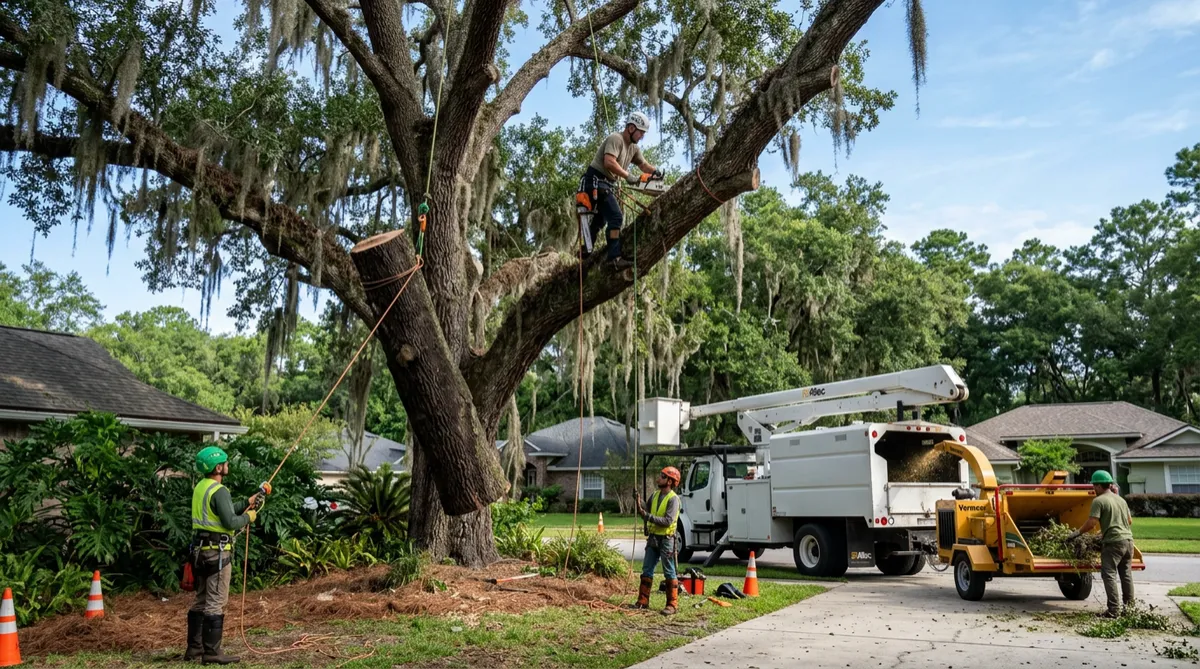
A well-managed removal is planned around the tree, crew, and nearby property. Ask who directs the work, how the area will be secured, and what cleanup is included. Depending on access, condition, and hazards, a job may use climbing and rigging, a bucket truck, or a crane.
- Assessment and scope: The professional reviews the tree, site, access, and potential targets, explains the recommendation, and documents whether stump and debris removal are included.
- Site preparation: The crew marks work and drop zones, protects people, and coordinates necessary utility or traffic controls. Move vehicles and keep children and pets away as requested.
- Controlled dismantling: Workers may lower limbs in sections with ropes and rigging or use a crane where that is safer or more practical. The plan should account for each piece’s weight and landing point.
- Trunk and debris: The crew sections the trunk and handles brush and wood as agreed. Stay out of the work zone until the crew confirms it is safe.
- Cleanup and stump: Confirm hauling, raking, and wood handling. Stump grinding can lower the stump below grade but does not remove every root; ask about depth, chips, access, and restoration.
Confirm scope, access, and cleanup in writing. If unexpected hazards or access limits change the plan, ask for an explanation and revised scope before work continues.

Hurricane Season, Insurance, and Choosing a Tree Professional
Do not wait for a storm to notice a hazard. Arrange an assessment before hurricane season, keep emergency access clear, and avoid topping or severe cutting as a quick fix. After a storm, stay away from hanging limbs and unstable trees. Never approach a downed wire; contact the utility or emergency responders. Storms, saturated ground, and high winds may also affect whether a crew can work safely.
Ask contractors for current proof of insurance appropriate to the crew and work, and clarify who supervises the job and whether a qualified arborist will assess it. Check relevant training or credentials, references, and local requirements. A credential is useful context, not a substitute for insurance and a clear scope. Be cautious of high-pressure storm offers or vague promises.
Get a written estimate identifying the tree, removal scope, debris and stump handling, site protection, and conditions that could change the work. For complex jobs, comparing qualified estimates can clarify the approach as well as cost. A responsible professional should explain practical alternatives without guaranteeing that a living tree can never fail.
Frequently Asked Questions
Does a leaning tree always need to be removed?
No. Some trees naturally grow at an angle, while a new or worsening lean—especially with lifted soil, cracks, or storm damage—can indicate instability. Keep people away from the potential fall area and arrange a prompt on-site assessment rather than trying to straighten or brace a large tree yourself.
Do I need permission to remove a tree on my property?
Possibly; requirements vary by city, county, property type, and tree circumstances. Check with the relevant local office and any homeowners’ association or property manager before work begins, and ask whether written approval or documentation is required.
Can a tree be removed during hurricane season?
Yes, when conditions are safe and any required approvals are in place, but storms, saturated ground, and high winds can affect scheduling and job safety. Address known hazards before severe weather if possible, and let the crew determine whether conditions allow work to proceed safely.
What happens to the stump after the tree is cut down?
Stump handling is usually a separate choice that should be discussed in the written scope. Grinding can leave the area more suitable for future landscaping, but it does not remove every root; ask about grind depth, chips, access, and restoration before deciding.
How do I know whether a tree company is properly insured?
Ask for current proof of insurance and confirm that the coverage is appropriate for the work and crew involved. Also request a written scope, clarify who supervises the job, and check any credentials or references that matter for your project.
If a tree on your property is declining, storm-damaged, or too close to a place people use, Arborman Tree Services can help you understand the options. Contact the team to arrange a free-estimate style consultation for your property in St. Augustine, Green Cove Springs, Interlachen, or the surrounding North Florida counties. A clear assessment can help you plan the next step with safety, local requirements, and cleanup in mind.
Website built by astreetgarage.com
