Tree Removal in St. Augustine, FL | Homeowner Guide
Tree removal is sometimes the safest way to protect a home, a driveway, or the people who use your yard. In St. Augustine, trees are part of the character of the landscape, from the live oaks shading the Old City to pines and palms in residential neighborhoods. But a tree that is dead, badly damaged, or increasingly unstable can become a serious concern. The right decision starts with a careful assessment, a clear plan, and work performed with safety in mind.

When should a tree be removed?
A tree may need to come down when its condition or location creates a risk that cannot reasonably be addressed through pruning or other care. Warning signs can include a large dead section, extensive decay, a split trunk, major cracks, or roots that have lifted or broken around the base. A tree leaning more than it used to, especially after a storm or ground disturbance, deserves prompt attention. So does a tree with hanging or broken limbs over a roof, driveway, sidewalk, or play area.
Some problems are less obvious. Mushrooms at the base, cavities, soft or hollow areas, and repeated limb failure may point to structural or health concerns. A canopy that has thinned substantially or branches that fail to leaf out can indicate stress, though these signs do not by themselves prove that removal is necessary. Florida weather, soil conditions, pests, disease, construction, and drainage changes can all affect a tree. A qualified assessment helps distinguish a correctable issue from a hazard that should be removed.
Species matter, but a species name alone is not a reason to cut a tree. A mature live oak can provide deep shade and a strong presence, while a laurel oak may decline as it ages or after injury. Pines can be vulnerable to root disturbance and storm damage; palms have different growth patterns and care needs; sweetgum can create seasonal yard-maintenance concerns. The tree’s health, structure, size, location, and surroundings all belong in the decision.
Start with an on-site assessment
Before work is scheduled, the tree and the work area should be evaluated in person. A careful assessment considers the trunk and major limbs, the root zone, the direction and condition of the canopy, and signs of decay or recent damage. It also considers what lies below and around the tree: homes, fences, sheds, vehicles, utility lines, neighboring property, landscaping, and access routes for equipment.
Share what you have observed, including when a lean or crack appeared, whether limbs have fallen, and whether the tree was affected by recent construction or a storm. Photos can help explain a concern, but they do not replace an on-site review when safety is involved. If a tree appears unstable or has damaged limbs, keep people and pets away from the area and avoid trying to climb, cut, or pull branches yourself.
The assessment should explain why removal is recommended, how the crew will protect nearby property, and what cleanup is included. If safe pruning could preserve the tree, ask whether that is a suitable option.
Check local rules before work begins
Tree rules vary by city, county, property type, and tree status. Before authorizing removal, check with your city or county about permits, protected or heritage trees, notices, and restrictions. Do not assume that private property or a tree’s poor condition automatically removes approval requirements.
A homeowners association, historic district, planned development, or conservation area may have added review steps. Ask the relevant office whether an application, inspection, or written approval is needed. Confirm requirements with the local authority before work starts.
Consider utility lines and underground services, too. Leave work near power lines to the utility or qualified professionals; never cut branches near electrical lines yourself. Confirm buried service locations before digging or using heavy equipment.
What a professional removal process looks like
- 1. Review the site: The crew confirms the tree, access, nearby structures, overhead hazards, ground conditions, and the agreed work scope.
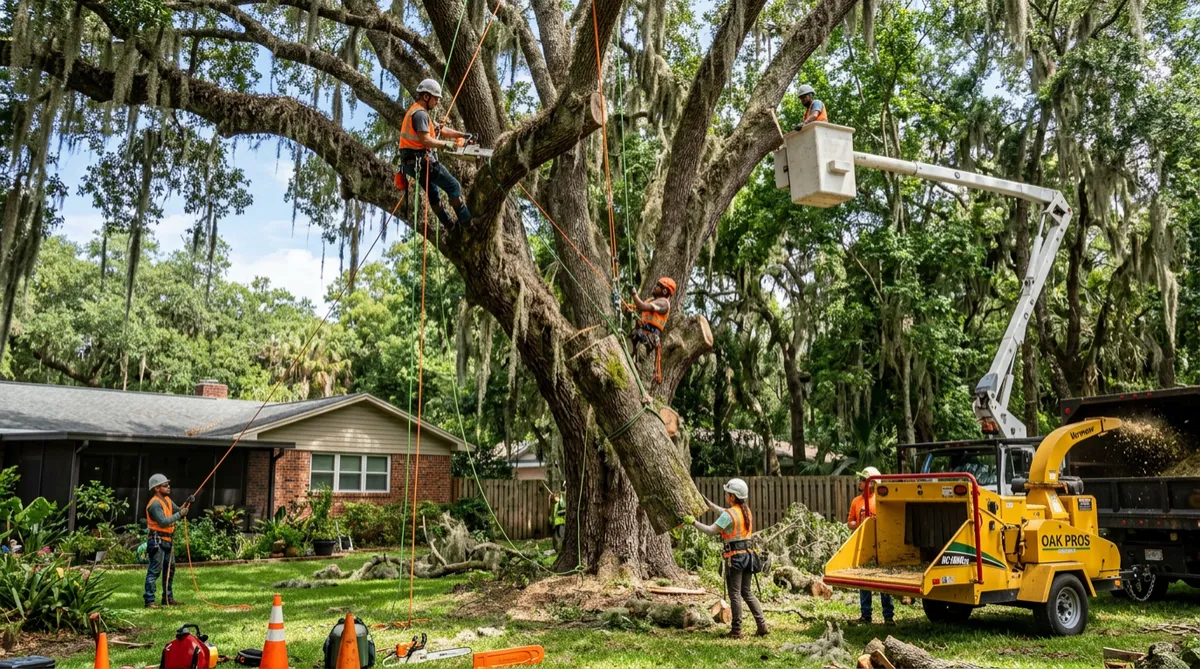
- 2. Set a work plan: The removal method is chosen for the tree and its surroundings. In a confined yard, a crew may remove the tree in controlled sections rather than fell it in one piece.
- 3. Secure the area: Workers establish a safe work zone, coordinate the crew, and use appropriate protective equipment and rigging where needed. People, pets, and vehicles should remain outside the marked area.
- 4. Remove the tree in stages: Branches and sections are cut and lowered or directed according to the site plan. The crew works methodically to limit uncontrolled movement and protect nearby property.
- 5. Handle wood and debris: The crew processes limbs and trunk sections according to the agreed scope. Discuss whether wood will be hauled away, left in manageable pieces, or handled another way.
- 6. Complete the cleanup: Raking, removal of smaller debris, and any stump work should be confirmed in advance. Stump grinding is commonly a separate decision, so ask whether it is included or can be arranged.
Weather may affect the schedule and the safest way to do the work. Wind, saturated ground, lightning, or other unsafe conditions can make tree work more hazardous. After a tropical storm or hurricane, there may be added risks from damaged trees, hanging limbs, blocked access, and unstable soil. A sound plan allows conditions to be reassessed rather than pressing ahead when it is unsafe.

Safety matters at every stage
Tree removal combines height, heavy wood, powered equipment, and unpredictable forces. Limbs can shift as they are cut, trunks can split, and a tree’s weight may not move as expected. Nearby roofs, glass, fences, vehicles, and utility lines make the work more complex. Even a small-looking tree can be difficult to remove safely if it is weakened, crowded, or close to a structure.
Hiring insured professionals helps protect the homeowner and crew if an unexpected incident occurs, but insurance is not a substitute for safe practices. Ask for confirmation of appropriate coverage and clarify who is responsible for the work area, debris, and any damage concerns. A professional crew should be able to explain its approach in plain language and should not pressure you to ignore safety concerns or local approval requirements.
Do not attempt to remove a large tree yourself, use a ladder with a chainsaw, or pull a tree with a vehicle or winch. A tree under tension or partially uprooted after a storm can move suddenly. Keep away from downed lines and report them to the utility or emergency services as appropriate. If there is immediate danger, protect people first and contact the appropriate responders.
Cost factors to understand
Tree removal costs depend on the work involved, not just the tree’s height. Important factors can include trunk diameter, tree condition, number and size of limbs, access for workers and equipment, proximity to structures or lines, and how carefully sections must be lowered. A confined backyard, steep or soft ground, extensive rigging, or storm damage may require additional planning. Hauling, log handling, stump grinding, and cleanup scope can also affect the estimate.
Ask for a written estimate that describes which tree is included, the removal method or key work steps, debris handling, stump treatment, cleanup, and any exclusions. Confirm whether permits or local approvals are the homeowner’s responsibility and whether the schedule depends on weather or access. Comparing estimates is most useful when each describes the same scope; the lowest number may not include the same protection or cleanup.
Preparing your St. Augustine property
St. Augustine’s setting makes thoughtful tree care especially important. Live oaks contribute to the leafy streets and historic character of the Old City, while trees around the Castillo de San Marcos, the Bridge of Lions, Anastasia State Park, the St. Augustine Lighthouse, and the Lightner Museum are familiar parts of the wider local landscape. These landmarks are reminders of the area’s history and coastal environment, not a reason to assume that any particular tree is protected. Local requirements depend on the tree and property, so verify them with the city or county.
Before a scheduled job, move vehicles and outdoor furniture away from the work zone, keep gates accessible, and secure pets indoors. Let the crew know about irrigation, landscape lighting, delicate plantings, or access restrictions. If neighbors may be affected by equipment or temporary access, advance communication can help avoid surprises. Take note of the agreed cleanup and ask the crew to review the completed work with you before leaving.
Storm and hurricane season is a useful time to review trees before conditions worsen. Look for newly exposed roots, cracked limbs, dead branches, and trees that have changed position. Avoid severe pruning intended to “hurricane-proof” a tree; improper cuts can harm its structure. Have concerning trees assessed well before a forecast storm when possible, and never schedule hazardous work during dangerous weather.
Where we work
Arborman Tree Services serves homeowners and properties across North and Northeast Florida, including St. Augustine and St. Johns County, Green Cove Springs, Interlachen, Putnam County, Flagler County, and Volusia County. Local tree types, site conditions, and municipal requirements can vary across these communities. For a property-specific recommendation, contact Arborman Tree Services for a free estimate and confirm applicable rules with your city or county.
Frequently Asked Questions
How can I tell whether a tree needs to be removed?
Look for major dead limbs, a split trunk, significant decay, lifted roots, a new or worsening lean, or repeated branch failure. These signs deserve an on-site assessment, especially when the tree is close to people, structures, or utilities. They do not automatically mean removal is the only option; the tree’s full condition and setting should guide the recommendation.
Do I need a permit to remove a tree in St. Augustine or St. Johns County?
Requirements depend on the property’s location, the tree, and applicable local rules. Contact your city or county before work begins to ask about permits, protected or heritage trees, and any other review steps. If you live in a historic district, community association, or conservation area, check for additional requirements as well.
Can a tree be removed close to my house or power lines?
Close quarters call for a careful, site-specific plan and may require a sectional removal with controlled lowering. Work near electrical lines should be handled by the utility or qualified professionals, not a homeowner. Tell the estimator about nearby structures and lines so the work plan can address them before scheduling.
Does tree removal include stump grinding and cleanup?
Not necessarily. Stump grinding, hauling, log handling, and the level of final cleanup can be separate items or vary by estimate. Ask for the scope in writing so you know what will be removed, what may remain, and whether additional work is needed after the tree is down.
When is the best time to remove a tree in Florida?
The best timing depends on the tree’s condition, weather, access, and local approvals. Address a safety concern promptly, but allow professionals to choose a safe work window. Planning ahead of storm season can help identify problems early; do not attempt removal during high winds, lightning, or other hazardous conditions.
If you are concerned about a damaged, declining, or poorly placed tree, contact Arborman Tree Services for a free estimate. A site-specific assessment can help you understand the options, the work involved, and the local checks to complete before scheduling.
Website built by astreetgarage.com
