Tree Removal in St. Augustine, FL | Arborman Tree Services
A declining or damaged tree can raise difficult questions: Is it still safe? Can it be saved? What happens if it comes down during a storm? For homeowners in St. Augustine and St. Johns County, tree removal deserves careful planning, especially where mature trees, homes, roads, and coastal weather meet. Arborman Tree Services helps property owners understand their options, prepare for responsible removal, and leave the site orderly. The right decision begins with an informed assessment—not a guess based on one visible crack or a windy afternoon.
When Is Tree Removal Necessary?
Removal may be the safest choice when a tree is dead, dying beyond recovery, structurally unstable, or severely damaged. Warning signs can include large dead limbs, a split trunk, major decay, extensive root damage, or a tree that has begun leaning in a new direction. Storm damage, repeated limb failures, and roots undermined by construction or saturated soil can also change a tree’s stability. One symptom alone does not always prove that removal is necessary, so a qualified professional should consider the whole tree and its surroundings.
Sometimes the concern is not the tree’s health but its location. A trunk or heavy limbs may threaten a home, driveway, utility area, or frequently used outdoor space. Roots can conflict with planned construction, and a tree may obstruct essential access. Before deciding, consider whether pruning, support, or a change to the proposed project could address the concern. A sound tree often provides shade, habitat, and beauty for decades; preserving it is worth exploring whenever it can be done safely.
In older St. Augustine neighborhoods, a tree’s relationship to nearby buildings, sidewalks, and established streets may make the decision more involved. A tree near a historic property or public space may also call for extra care in understanding applicable local requirements. Around Green Cove Springs and elsewhere in the county, site conditions can differ considerably from one property to another. An on-site assessment helps identify practical options before work is scheduled.
How Professional Tree Removal Works
Assessment and planning
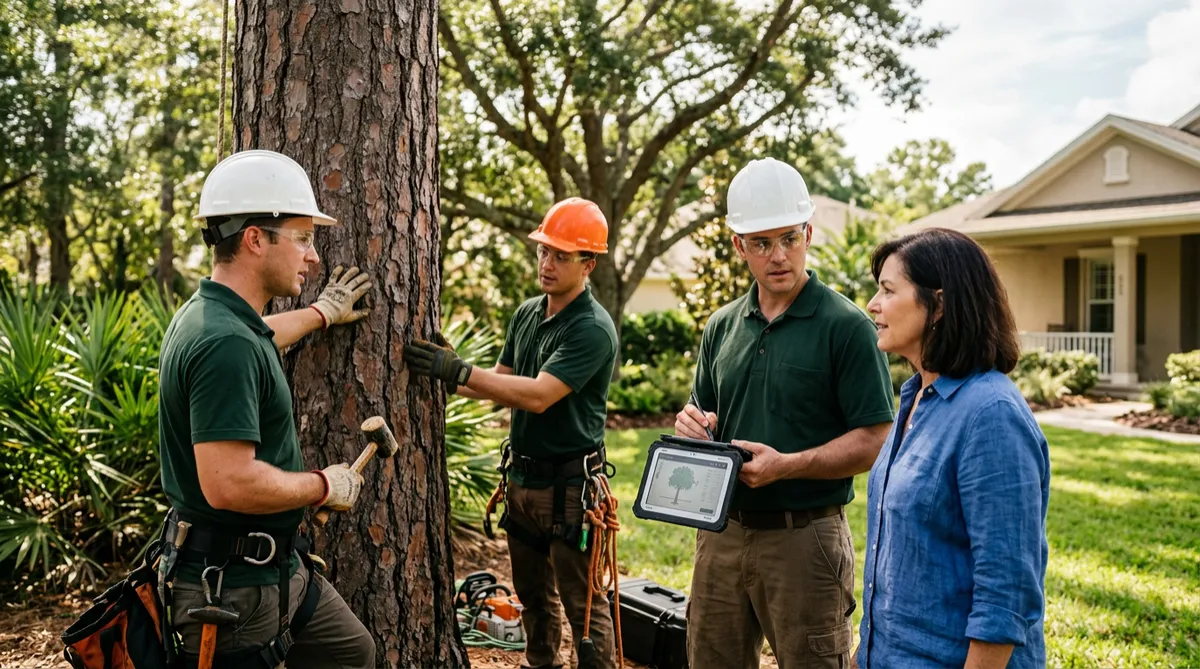
A responsible job starts with a site visit and a discussion of the homeowner’s concerns. The crew evaluates the tree’s condition, height, lean, branching pattern, access, and proximity to structures, fences, vehicles, landscaping, and overhead lines. They also consider ground conditions and where sections can be lowered or moved. The plan should make clear what is being removed, what will remain, how the work area will be protected, and what cleanup is included.
Local rules can vary by location, property, tree, and scope of work. Before work begins, ask who is responsible for checking whether a permit, review, or other approval is needed. Confirm any applicable local ordinance requirements with the appropriate local authority rather than relying on assumptions or an old rule of thumb. If a property is in a historic or otherwise regulated area, raise that detail during the estimate so the plan can account for it.

Controlled removal, rigging, and cranes
In an open area, a tree may be felled in a planned direction if there is sufficient room and the hazards can be controlled. In a crowded yard, the crew may instead remove it piece by piece. Climbers or an aerial lift can access the canopy, while ropes and rigging help lower limbs and trunk sections without letting them fall freely. A crane may be appropriate when the tree is large, access allows safe setup, and lifting sections offers a controlled solution. Equipment is chosen for the site and the risks; no single method fits every property.
Near Castillo de San Marcos, the Bridge of Lions, or the St. Augustine Lighthouse, familiar landmarks remind residents how closely homes, roads, and public places can sit together in the historic city. A landmark does not determine a property’s rules, but the same principle applies nearby: work must be planned around what is actually on site. The crew should establish a work zone, communicate the sequence, and keep bystanders clear while each section is cut and handled.

Cleanup and final walkthrough
Agree on cleanup before the crew starts. Depending on the estimate, work may include hauling away limbs and trunk wood, chipping brush, clearing the work area, and cutting the remaining trunk to an agreed height. Stump grinding is often a separate service and should be discussed if desired. Wood left for the homeowner, driveway access, and protection of lawn or planting beds should also be clarified. At completion, walk the site together and confirm that the agreed work and cleanup have been addressed.
Safety Comes First
Tree work involves chainsaws, heavy wood, elevated work, and equipment that can affect people and property beyond the tree itself. Homeowners should keep children, pets, and visitors away from the work zone and follow the crew’s directions. Do not approach a tree while it is being cut or attempt to assist by pulling limbs or moving equipment. If a tree or branch is touching a power line, treat it as dangerous and contact the utility or emergency services as appropriate; never try to move it yourself.
Before hiring, ask how the crew will control falling material, protect nearby structures, and manage access. A clear plan should address the specific hazards, not merely promise that the job will be quick. Work near public paths, neighboring properties, or parked cars may require additional coordination. Good communication before and during the job is part of safety, not an optional extra.
What Affects Tree Removal Cost?
There is no reliable one-size-fits-all price for tree removal. The estimate depends on the tree’s size and condition, its location, and the complexity of safely taking it down. A large tree close to a house can require more time and controlled rigging than a smaller tree with open space around it. Limited equipment access, difficult ground conditions, obstacles, and the need for a crane can also affect the work plan.
Other factors include the amount of material to process or haul away, whether wood will be left on site, the extent of cleanup, and whether stump grinding is included. Storm-damaged trees may have unstable limbs or altered tension, making them more hazardous to handle. Ask for a written estimate that describes the scope, cleanup, stump treatment, and any assumptions about permits or access. Comparing clearly defined scopes is more useful than comparing vague totals.
Live Oak and Pine Considerations
Live oaks
Live oaks are a defining part of Northeast Florida’s landscape. Their broad crowns and substantial limbs can shade a home beautifully, but their size means that removal near buildings may call for careful sequencing and rigging. Before removing a live oak, ask whether pruning or another management option could address the concern. If removal is needed, the crew should account for the canopy’s spread, limb weight, nearby targets, and the space available for equipment. Mature trees can also be subject to local protections, so verify requirements before scheduling work.
Pines
Pines often grow tall and may have a different structure and failure pattern from broad-canopied oaks. Storm damage, root disturbance, dead tops, or a pronounced lean warrant professional attention, especially when a tree is within reach of a home or access route. The removal plan should consider where the top and trunk sections can be controlled and whether surrounding trees or structures limit the drop zone. Never judge a pine’s safety by appearance alone; a qualified assessment can help determine whether monitoring, pruning, or removal is appropriate.
Hurricane-Season Readiness
Preparation is best done before a storm is in the forecast. Look for dead or broken branches, visible root changes, and trees that have shifted or sustained recent damage. Arrange an assessment early enough to consider options and any applicable local requirements. Proper pruning can sometimes reduce specific hazards, but indiscriminate topping is not a substitute for sound tree care and can create new problems.
St. Augustine and St. Johns County residents should also think about where branches could land, whether driveways and emergency access could be blocked, and how a tree’s condition may affect neighboring property. Along the St. Johns River and in communities with wet or variable ground, site conditions can influence access and stability. Ravine Gardens State Park in Palatka and Anastasia State Park are reminders of the region’s varied landscapes; conditions in a managed natural area differ from a residential yard, so a home’s trees need an individual evaluation. Do not wait until high winds are approaching to arrange routine work. During and after severe weather, stay clear of damaged trees and contact qualified help.
Choosing a Qualified, Insured Arborist
Choose a tree-care professional who can explain the recommended work in plain language and provide proof of appropriate insurance. Ask what coverage applies to the work and request current documentation; do not rely only on a verbal assurance. Find out who will perform the job, what equipment is planned, what the crew will do to protect people and property, and how debris and the stump will be handled. A careful provider welcomes reasonable questions and does not pressure you to approve unnecessary work on the spot.
Ask for a written estimate and clarify who will check local permit or ordinance requirements. If the tree may be preserved, ask for the reasoning behind removal and whether a less extensive option is suitable. A trustworthy arborist describes both the benefits and limitations of each approach. That kind of conversation is valuable whether your home is near Flagler College in St. Augustine, in a growing part of St. Johns County, or near Spring Park in Green Cove Springs.
Frequently Asked Questions
How can I tell if a tree needs to be removed?
Look for changes such as major dead limbs, significant trunk decay, a new lean, root damage, or serious storm injury, but do not make the decision from one sign alone. Have a qualified tree professional assess the whole tree, its surroundings, and whether preservation options are practical.
Do I need approval before removing a tree in St. Augustine or St. Johns County?
Requirements can depend on the property, tree, and work proposed. Ask the contractor to identify what needs checking, then confirm applicable requirements with the relevant local authority before work begins. Avoid relying on an assumed rule or a requirement from a different property.
Can a tree be removed without damaging my home or yard?
A careful plan can reduce risk, but no tree-work method can promise zero impact in every setting. The crew should evaluate access, nearby structures, landscaping, and ground conditions, then explain how it will control sections and protect the work area.
Is stump grinding included in tree removal?
Not always. Removal, hauling, and stump grinding may be priced or scoped separately. Ask whether the stump will remain, be cut to a particular height, or be ground, and clarify how the resulting chips and surface will be handled.
Should I remove a tree before hurricane season?
Not automatically. Arrange an assessment well before storm conditions, especially for damaged or concerning trees. A professional can explain whether pruning, monitoring, or removal is appropriate and allow time to check any local requirements. Never attempt tree work during high winds or near storm-damaged power lines.
If you have a tree you are concerned about in St. Augustine, St. Johns County, Green Cove Springs, or Putnam County, contact Arborman Tree Services to discuss an on-site assessment and request a free estimate. Share what you have noticed and ask about the recommended scope, safety plan, cleanup, and any local requirements to verify. A thoughtful conversation can help you make a confident decision for your property.
Website built by astreetgarage.com
