Tree Removal in St. Augustine & Northeast Florida
A tree can be a defining feature of a Northeast Florida home: welcome shade, a sense of place, and a living part of the landscape. But when a tree is dead, badly damaged, or creating a serious safety concern, removal may be the most responsible option. The decision deserves careful attention, especially where mature trees stand close to homes, fences, driveways, and utility lines.
For homeowners in St. Augustine and St. Johns County, changing weather, sandy soils, and established neighborhoods can make tree decisions feel especially personal. This guide explains signs that may call for removal, what a professional process can involve, how to prepare, and what to consider after the tree is gone.

When might tree removal be necessary?
Not every leaning, declining, or storm-damaged tree needs to come down. A qualified tree professional can assess the tree, its surroundings, and the nature of the concern. Removal may be appropriate when defects or damage cannot be managed safely through pruning or other care.
- Major decline or death: Extensive dead branches, a failing crown, or a tree that no longer shows healthy growth may warrant an evaluation. A dead tree can become less stable as decay progresses.
- Structural damage: A split trunk, a large crack, a partially uprooted root plate, or a substantial broken limb can signal a serious hazard, particularly after a storm.
- A new or worsening lean: A tree that has recently tilted, heaved the soil around its base, or shifted after heavy rain should be assessed promptly. Lean alone does not prove a tree is unsafe, but a change can be important.
- Root or trunk problems: Visible decay, cavities, damaged roots, or fungal growth near the base may affect stability. Roots can also conflict with foundations, paving, or buried utilities; a professional can help distinguish a real risk from ordinary surface roots.
- Dangerous proximity: A tree or major limb over a home, occupied area, driveway, or service line may require action if its condition creates an unacceptable risk.
When a tree is near electrical lines, keep people away and contact the utility company or an appropriately qualified professional. Do not attempt to cut branches or operate equipment near energized lines. If a tree has fallen onto a building or is blocking access after a storm, keep clear of unstable limbs and damaged structures until the area can be assessed.
Why an on-site assessment matters
A photograph can help explain a concern, but it cannot show every detail that affects a removal plan. An on-site review considers the tree's height, condition, branching, lean, access, nearby targets, and the available space for lowering or moving pieces. The assessor may also ask about recent changes, storm damage, prior pruning, and your goals for the yard.
Removal is not automatically the best answer to every concern. Depending on the tree and site, pruning, monitoring, or other tree care may be worth discussing. Ask the professional to explain what they observed, why removal is being recommended, and whether any practical alternatives are available. A clear explanation helps you make an informed decision rather than relying on a single symptom.
How professional tree removal works
Each property is different, and the work plan should fit the tree and the site. A typical process begins with an assessment and a discussion of access, hazards, the scope of work, and cleanup expectations. Before work begins, the crew should establish a work area and identify people, vehicles, landscaping, structures, and overhead or underground utilities that could affect the job.
Sectional removal and rigging
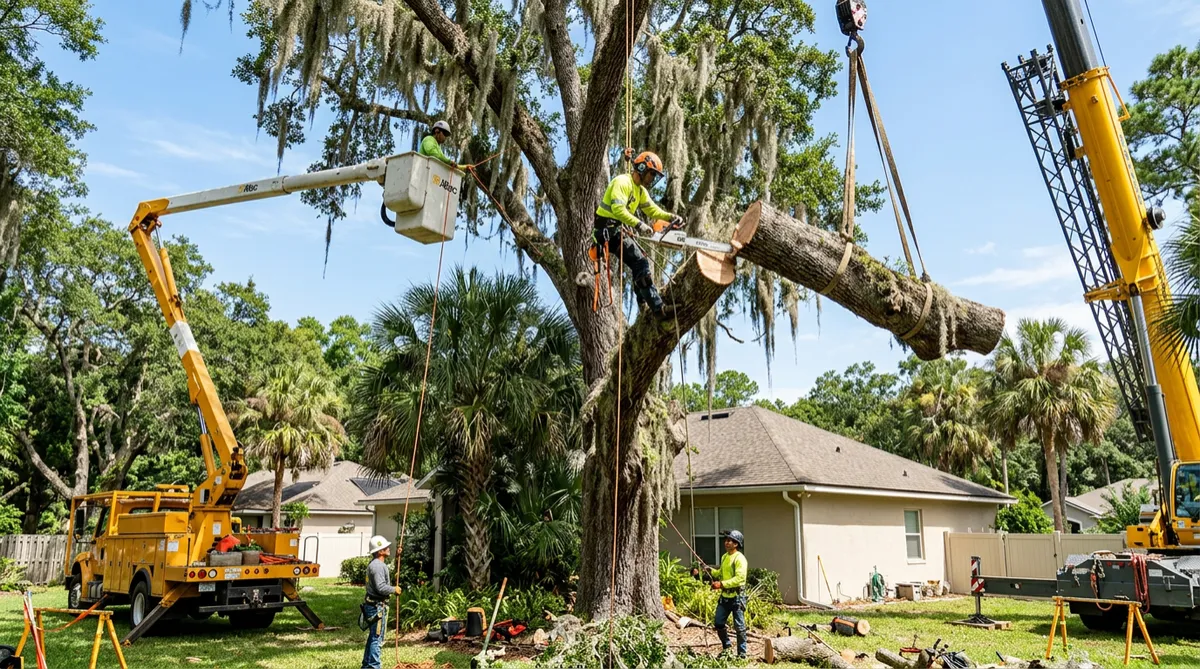
Where a tree cannot be felled safely in one direction, a crew may remove it in sections. Climbers or an elevated work platform can reach selected limbs and trunk sections; rigging ropes and lowering devices may help control how pieces descend. This approach can be useful in a confined backyard, but it requires training, planning, and coordination. The crew determines the method based on the tree, equipment, access, and site conditions.
When a crane may be considered
A crane can sometimes lift sections away from a congested or difficult-to-access area. It is not needed for every removal, and using one depends on available setup space, ground conditions, reach, overhead clearance, and the weight and shape of the sections. The removal professional should explain the proposed approach and any access or site preparations it requires.
Controlled felling
If there is adequate clearance and the tree can be directed into a suitable landing zone, a professional may use a planned felling method. A safe landing area must account for the tree's height, its condition, its lean, wind, and nearby hazards. A yard that looks open from the ground may still have obstacles or limited clearance that affect the plan.
Safety, permits, and questions to ask
Tree work involves serious hazards, including falling wood, chainsaws, elevated work, heavy equipment, and nearby utilities. A professional crew should communicate the work area and keep bystanders clear while work is underway. Let the crew know about gates, pets, children, irrigation, lighting, septic features, and other conditions that could affect access or cleanup.
Before scheduling, ask whether a permit or review may be needed for your property. Requirements can vary by municipality, county, tree type, and site. Live oaks and other heritage trees are valued across the region and may be subject to local rules. Check with your city or county about permits and protected-tree ordinances before authorizing removal; do not assume a tree can be removed without checking.
It is also reasonable to ask what insurance coverage applies to the work. Request current proof of insurance and ask the company to explain its coverage for property damage and worker injuries. Clarify who is responsible if damage occurs, what the estimate includes, and whether the crew expects to use subcontractors. Written answers help set clear expectations; they are not a substitute for reviewing the actual documents.
Why do-it-yourself removal can be risky
Removing a tree is not simply a matter of making a cut and stepping away. A trunk or limb can move unpredictably under tension, catch another branch, or fall outside the expected direction. Ladders, chainsaws, ropes, and improvised pulling methods can add risk, especially around buildings, fences, vehicles, and utility lines.
Even a small-looking tree can be heavy, unstable, or difficult to control. For a large tree, one with visible defects, or any tree close to a structure or line, leave the work to trained professionals with appropriate equipment. Never climb with a chainsaw, work beneath hanging limbs, or attempt to clear a tree from electrical lines. If you are unsure whether a tree presents an immediate hazard, keep people away and arrange a professional assessment.
What affects the scope and cost?
There is no single removal plan or price that fits every tree. An estimate can reflect several site-specific factors, such as:
- Tree height, trunk diameter, species, condition, and the amount of dead or damaged wood.
- Proximity to a home, shed, fence, pool, landscape feature, road, or utility line.
- Whether the tree can be felled into a clear area or must be dismantled in sections.
- Access for a crew, lift, crane, chipper, or hauling equipment, including gate width and ground conditions.
- The amount of brush and wood to remove, the requested cleanup level, and whether stump grinding is included.
- Site preparation, debris handling, or other work requested alongside removal.
Ask for a written estimate that spells out the tree or trees included and the planned cleanup. Confirm whether the stump, wood, branches, and chips will be left, hauled away, or handled another way. If you are comparing estimates, check that they describe similar scopes of work rather than comparing only a bottom-line amount.

What to expect after removal
Once the tree is down, cleanup can include cutting the trunk into manageable sections, chipping branches, and removing or stacking debris according to the agreed scope. Stump grinding is often a separate option, so ask whether it is included and what the finished area will look like. Grinding can leave wood chips and may not remove every root; discuss how the area will be left and what preparation is needed for the next use.
Some homeowners choose to replant. Consider the mature size of a replacement tree, its distance from the house and utilities, the available sunlight, drainage, and the amount of space for roots and canopy. Native species suited to the site can support a landscape that feels at home in Northeast Florida. A local tree professional or nursery can help you consider suitable choices and placement.
Tree removal in Northeast Florida communities
From historic St. Augustine neighborhoods near the Castillo de San Marcos and the Bridge of Lions to homes near the St. Augustine Lighthouse, tree work must account for the character and layout of each property. The same is true around Anastasia State Park, World Golf Village, and communities throughout St. Johns County. Mature live oaks offer valued shade, but their size, condition, and proximity to buildings deserve careful evaluation.
Homeowners in Green Cove Springs may recognize the distinctive setting around historic Spring Park, while properties near the St. Johns River can have their own access and site considerations. Further inland, Crescent Lake and Ravine Gardens State Park near Palatka are familiar Putnam County landmarks. The service area also includes Flagler County, with places such as Flagler Beach Pier and Washington Oaks Gardens State Park, and Volusia County, where Ponce Inlet Lighthouse and Daytona Beach are well-known destinations.
These landmarks provide a sense of the region, not a statement about conditions on any specific property. Tree health, soil, wind exposure, access, and local requirements differ from lot to lot. Whether you are in St. Augustine, elsewhere in St. Johns County, Interlachen, Flagler County, or Volusia County, base the decision on an on-site assessment and check permit questions with your city or county.
Frequently Asked Questions
How can I tell whether a tree needs to be removed?
Look for changes such as a new lean, a split trunk, major dead limbs, root-plate movement, or extensive decline. These signs do not establish a diagnosis on their own, so arrange an on-site assessment, especially if the tree is near a place people use.
Do I need permission to remove a live oak in St. Augustine or St. Johns County?
Permit and protected-tree requirements can depend on the exact property and applicable local rules. Live oaks and heritage trees are valued locally and may be subject to ordinances, so check with your city or county before authorizing removal.
Will the tree crew remove the stump and all the debris?
That depends on the scope you approve. Ask whether stump grinding, hauling logs, chipping branches, and removing chips are included, and confirm how the crew will leave the area.
Is it safe to remove a tree myself?
Tree removal can involve falling wood, unstable limbs, chainsaws, and serious hazards near structures or power lines. For a large, damaged, or poorly positioned tree, use a qualified professional and keep people away from the work area.
What should I ask before accepting a tree-removal estimate?
Ask what work is included, what happens to the stump and debris, how the crew plans to manage nearby hazards, and whether insurance documentation is available. Also check whether local permits or protected-tree rules apply to your property.
Website built by astreetgarage.com
