Tree Removal in St. Augustine & St. Johns County
Tree removal is rarely a homeowner’s first choice. In Northeast Florida, mature trees shade homes, frame neighborhood streets, and give properties character. Around St. Augustine, live oaks are part of the landscape—from the canopy of historic downtown to residential streets near the Castillo de San Marcos and Flagler College. Yet a tree that is dead, unstable, badly damaged, or poorly positioned can threaten people and property. Knowing when removal is appropriate, what a careful job involves, and what to ask before hiring a crew can help you make a sound decision.

When Is Tree Removal Necessary?
Removal may be the responsible option when a tree is dead or dying, has extensive structural damage, or cannot be made acceptably safe through pruning or other care. A tree with major trunk decay, severe root failure, or large dead limbs over a home may pose a risk that continues to grow. Trees can also become hazardous after lightning, flooding, construction injury, or strong winds, even when the damage is not obvious from the ground.
Location matters, too. A tree growing into a building, blocking essential access, or interfering with planned work may require removal when alternatives are impractical. In close-set neighborhoods from St. Augustine to Ponte Vedra, a tree’s canopy and root zone may extend over several yards, fences, driveways, or utility areas. A qualified arborist can assess whether selective pruning, cabling, or changes to nearby activity could address the concern instead. Removal should follow a reasoned evaluation, not a quick guess based on appearance alone.
A professional assessment considers the whole tree, its site, recent changes, and the likely consequences of failure. If removal is recommended, ask why pruning or other care would not adequately resolve the concern.
Warning Signs to Take Seriously
Homeowners can notice possible problems, but a visual check from the ground cannot establish that a tree is safe. Look for changes and seek a professional opinion when something seems abnormal. Warning signs may include:
- Large dead branches, a thinning crown, or a sudden decline in leaf growth compared with previous seasons.
- Cracks in the trunk or major limbs, split unions, hanging branches, or fresh breaks after a storm.
- Fungal growth near the trunk or roots, cavities, soft or decayed wood, or oozing areas. These clues deserve attention but do not, by themselves, prove that a tree must be removed.
- Soil lifting, newly exposed roots, a changing lean, or recent ground movement around the base.
- Branches touching a roof or obstructing a walkway, or roots affecting hard surfaces and nearby structures.
Compare the tree with its past condition and note when symptoms appeared. A new crack or rapidly developing lean warrants prompt attention, especially if the tree could reach a home, road, or frequently used area. Keep people away from a suspected hazard and do not climb, cut, or attach ropes to it yourself. Following severe weather, hidden splits and damaged limbs may remain under tension, creating risks that are difficult to judge without training and suitable equipment.
How a Professional Tree Removal Works
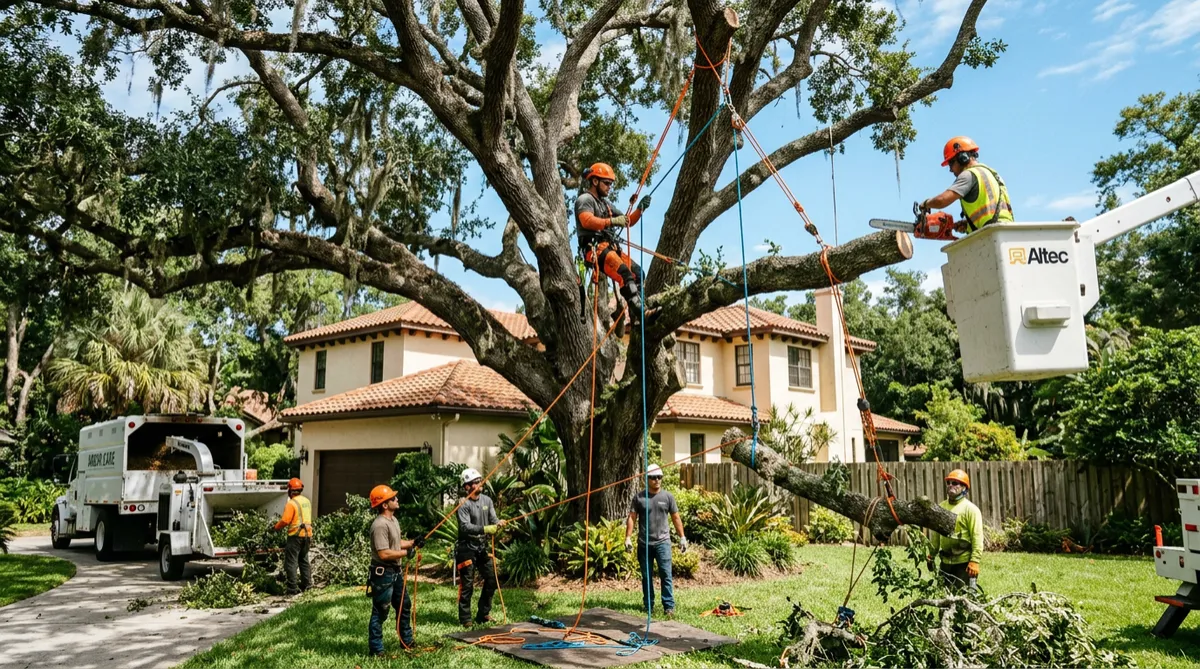
A careful removal begins well before a saw starts. The crew should review the tree, surrounding structures, access, overhead hazards, and the intended drop or lowering zone. They will discuss the scope, identify what is included, and plan how people, equipment, wood, and debris will move through the site. A sound plan also accounts for nearby trees, landscaping, fences, driveways, and the possibility of changing conditions.
- Assess and plan. The arborist evaluates the tree’s condition, size, lean, branch structure, and surroundings. The team identifies hazards, establishes a work zone, and chooses an approach suited to the site.
- Prepare the property. The crew communicates access needs and protects or clears the agreed work area. They use appropriate protective equipment and keep bystanders outside the controlled zone. If wires or other utility hazards are involved, the work plan must address them safely rather than treating them as ordinary obstacles.
- Choose how to dismantle. Where there is open, unobstructed space, a tree may be felled in a planned direction. In a tight yard—common among older homes near historic downtown or along established St. Augustine neighborhoods—climbers may remove branches and trunk sections in stages. Rigging ropes, pulleys, and suitable anchor points help lower pieces rather than letting them fall freely.
- Use specialized access when appropriate. A lift or crane may be considered when a tree is difficult to climb, when access allows the equipment, or when lifting sections offers a safer controlled method. A crane is not necessary for every removal. The crew should explain why its chosen equipment fits the tree, site, and access conditions.
- Remove the remaining trunk and clean up. After branches and upper sections are managed, the crew cuts the remaining stem according to the plan, processes the wood, and completes the agreed cleanup. If stump grinding is included, it is usually a distinct part of the work and should be clarified in advance.
Rigging is about controlling the movement of wood, not simply tying a rope around a branch. Loads, angles, anchor points, and the condition of the tree all matter. Experienced crews adapt as the tree is dismantled and stop if conditions change. Homeowners should stay outside the marked work zone and follow crew instructions, even when watching from a familiar part of the yard.

Permits and Local Tree Rules
Before scheduling removal, ask whether local review or a permit may apply. Requirements can depend on the tree’s location, size, condition, property status, and the authority responsible for the site. Rules may differ between the City of St. Augustine, unincorporated areas of St. Johns County, and other nearby municipalities. Protected or heritage trees may receive additional consideration, and work on a property in a designated historic area may involve separate review.
Do not assume a tree can be removed simply because it is on private property, or that a contractor’s recommendation replaces required approval. Contact the City of St. Augustine or St. Johns County directly to ask about current requirements for your address and tree. If the property is in another jurisdiction, check with that local government. Clarify who will obtain any required approvals and when work may begin. A reputable provider should be willing to discuss this step without promising an exemption or inventing a rule.
What Affects the Cost?
Estimates depend on the tree’s size, species, condition, access, and proximity to homes, utilities, and landscaping. A complicated removal may require climbing, rigging, or specialized equipment to control sections in a tight space.
Hauling and disposal, stump grinding, wood processing, site protection, and final cleanup can affect the scope. Storm-damaged trees may need extra care because broken limbs can be unstable. Ask for a written estimate specifying the trees, work method, cleanup, stump treatment, protections, and exclusions. Compare estimates with the same scope, and make sure the provider has inspected the property.
Choosing a Licensed and Insured Arborist
Tree work combines heavy equipment, elevated work, sharp tools, and unpredictable wood under load. Choose a professional who can explain the assessment clearly and provide current documentation for applicable licensing and insurance. Ask what coverage applies to the work and whether employees and subcontractors are included. Verify details with the issuing organization or insurer if you have questions; do not rely on a verbal assurance alone.
Ask who will supervise the job, how the crew will control the work zone, and what they will do to protect buildings, paving, and plantings. If a tree-health evaluation is important, ask about the qualifications of the person conducting it and whether they hold a recognized arborist credential. Credentials and insurance are separate questions: confirm both rather than assuming one guarantees the other. A careful provider welcomes reasonable questions, provides a clear written scope, and does not pressure you into immediate work without explaining the concern.
Stumps, Debris, and Aftercare
Agree on what “removal” includes: hauling or chipping branches and logs, final cleanup, and stump grinding may be separate. If grinding is included, clarify the depth, surface-root treatment, and whether chips stay or are removed. Grinding reduces the visible stump but does not remove every root.
Keep people and pets clear until the crew leaves and says the area is safe; the ground may be uneven and chips can settle. For replacement planting, consider mature canopy, utilities, drainage, and distance from structures. Coastal properties near the Matanzas River or Vilano Beach may have different exposure and drainage, so choose for the specific site.
Storm-Season Considerations
Northeast Florida homeowners should think about tree condition before severe weather arrives, not only after a warning is issued. Schedule an assessment for large dead limbs, cracks, or trees with recent changes while there is time to make a considered plan. Pruning should be done thoughtfully: excessive or improper cutting can harm a tree and may leave it more vulnerable. A professional can distinguish routine maintenance from a condition that calls for more urgent action.
Arrange an assessment when it is safe if you see a split, hanging limb, lifted soil, or sudden change in lean. Keep away from damaged trees and never cut near utility lines. Address less urgent concerns before the next storm season rather than waiting for more damage.
Frequently Asked Questions
How can I tell if a tree needs to be removed?
Dead wood, trunk cracks, root movement, and a sudden lean are reasons to request a professional assessment, not automatic proof that removal is required. An arborist considers the tree’s overall condition, targets it could reach, and whether practical care can reduce the risk. If there is an immediate danger, keep clear and seek prompt professional help.
Do I need permission to remove a tree in St. Augustine?
It depends on the property’s jurisdiction and the tree’s circumstances, including whether it is protected or in a historic area. Ask the City of St. Augustine or St. Johns County about current requirements for your specific address before work is scheduled. Do not rely on a general answer for a different property.
Can a large tree be removed in a small yard?
Often, a tree can be dismantled in sections using climbing and rigging techniques, provided the site and tree permit a safe plan. A lift or crane may be an option where access and conditions allow. The provider should inspect the site and explain how sections, equipment, and debris will be controlled.
Does tree removal include stump grinding?
Not necessarily. Stump grinding, hauling, and final cleanup may be priced or scoped separately, so confirm each item in writing. Ask what happens to the chips and how the finished area will be left.
When should I schedule an inspection after a storm?
Arrange an assessment as soon as it is safe if you see a split, hanging limb, lifted soil, or a sudden change in lean. Keep people away from the hazard and never cut near utility lines. Less urgent concerns can still be addressed before the next storm season rather than waiting for additional damage.
Plan Tree Work with Care
Whether a tree stands near historic downtown, overlooks a neighborhood street, or shades a home elsewhere in St. Johns County or Flagler County, the best decision begins with a site-specific assessment. A sound plan respects the tree, the property, local requirements, and everyone’s safety. Contact Arborman Tree Services to discuss your tree and request an estimate. Share what you have observed, ask what the proposed work includes, and confirm any local approvals before scheduling.
Website built by astreetgarage.com

