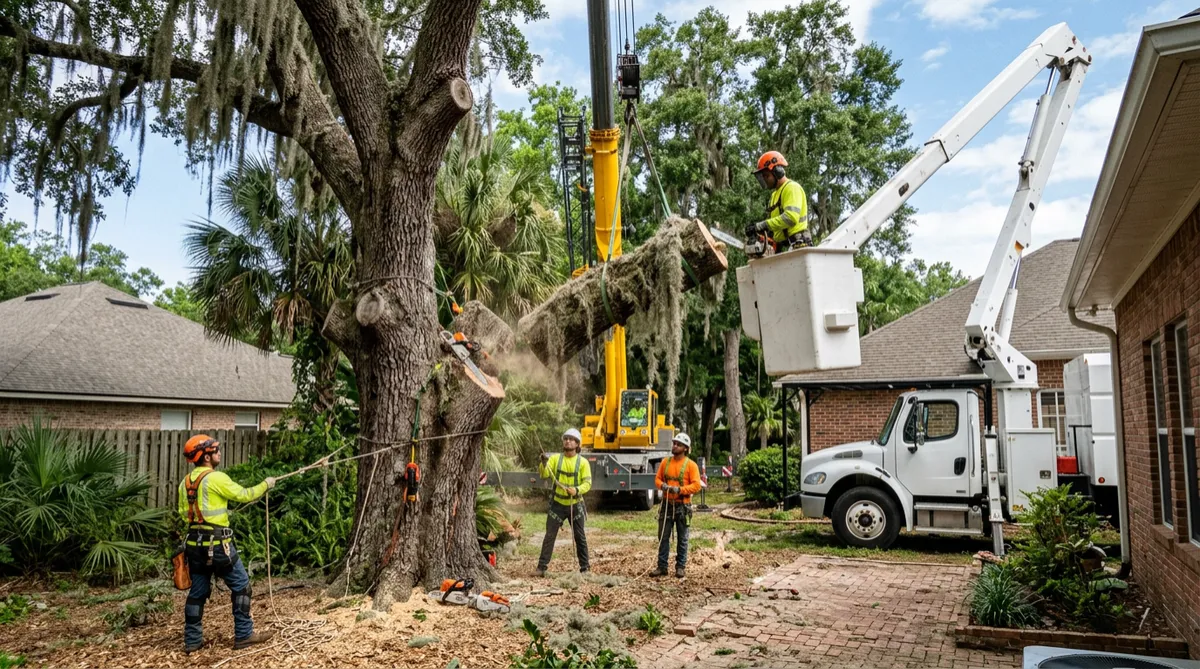
Tree Removal in St. Augustine & St. Johns County
When a tree becomes unstable, diseased, or too close to a home, deciding what to do can feel daunting. In St. Augustine and across St. Johns County, trees are part of the character of a neighborhood—from live oaks shading older streets near Flagler College to pines and palms in newer communities. But a tree that threatens people or property may need professional attention. A careful assessment can help you understand whether removal is necessary, how the work can be done safely, and what to consider before choosing a contractor.

When Is Tree Removal Necessary?
Removal is usually a last resort, not the automatic answer to a tree problem. An arborist may be able to recommend pruning, cabling, soil or root-zone care, or simply monitoring the tree. Removal becomes more likely when a tree is dead or failing, has extensive structural damage, is affected by a serious disease or pest, or cannot be made acceptably safe in its location.
Sometimes the issue is the site rather than the tree’s health. Roots may be damaging a foundation, driveway, or underground service; branches may be in persistent conflict with a roof or utility line; or construction may make it impossible to protect the trunk and root zone. A qualified professional can explain the risks and alternatives, and distinguish a genuine hazard from ordinary seasonal leaf drop, minor deadwood, or a tree that merely needs routine maintenance.
In coastal and inland northeast Florida, storms can change the picture quickly. A live oak that has stood for decades may have hidden decay, while a pine with a compromised root plate can become less stable in saturated soil. Hurricanes and strong thunderstorms can break limbs, expose defects, or leave a tree leaning. A fresh lean, a split trunk, or a tree hanging over a home after a storm deserves prompt professional evaluation. Keep people away from the area and do not approach a tree touching a power line.
Signs a Tree May Need to Come Down
No single symptom proves that a tree must be removed. Look for patterns and changes over time, and ask an experienced professional to assess the whole tree, including its roots, trunk, crown, and surroundings. Warning signs include:
- Major trunk cracks or splits: Deep, widening cracks, separated stems, or a split extending into a main union can indicate a serious structural weakness.
- Extensive decay or cavities: Mushrooms or conks at the base, soft or hollow-sounding wood, and large cavities may point to decay. Their significance depends on the tree’s structure and the amount and location of affected wood.
- Root or soil movement: Newly exposed roots, heaving soil, a lifted root plate, or cracking ground around the base can signal loss of stability, especially after heavy rain or high winds.
- Sudden or worsening lean: A new lean, particularly with cracked soil or broken roots, needs urgent attention. A longstanding lean is not automatically unsafe, but it should be evaluated if it is changing.
- Large dead branches or a declining crown: Widespread deadwood, sparse foliage, or dieback spreading through the crown may reflect injury, disease, pests, or root stress.
- Repeated storm damage: A tree that has lost major limbs or has several damaged unions may have a greater chance of further failure.
Florida’s heat, humidity, sandy soils, and alternating wet and dry periods can all affect tree health. Laurel oaks, pines, palms, and live oaks each have different growth habits and failure concerns, so a diagnosis should be specific to the species and site. A palm, for example, does not grow new trunk wood the same way a broadleaf tree does; dead fronds or a damaged crown call for informed evaluation rather than guesswork.
How a Safe Tree Removal Works
1. Assessment and work planning
The crew should assess the tree, its condition, access, nearby homes, fences, utilities, and other hazards before work begins. Ask for a clear written scope describing the work zone, equipment, property protections, and debris handling. If the tree is near a road, neighbor, or utility, address those constraints in advance. A certified arborist can help assess condition and alternatives; credentials do not replace insurance, trained workers, and a safe plan.
2. Rigging, climbing, or crane work
Where space allows, the crew may fell a tree in a controlled direction. In tight St. Augustine yards, trained workers often remove it in sections, using ropes and rigging to lower limbs away from buildings. A crane may suit a large, compromised, or hard-to-access tree, but requires a stable setup and coordinated lifting plan. Equipment should match the site, not replace planning. Stay outside the marked work zone and follow crew instructions.

3. Debris removal and cleanup
Once the tree is down, the crew typically cuts limbs and trunk sections into manageable pieces, chips brush if that service is included, and removes or stages the wood according to the agreed scope. Before work begins, confirm whether hauling, firewood-sized logs, chip disposal, and raking or blowing the work area are included. Tree work can disturb lawn, beds, gates, or driveway surfaces, so ask how equipment will reach the site and what protections are planned. Walk the area with the contractor after the job to review the completed work.
Permits and Local Rules to Check First
Do not assume that a tree on private property can always be removed without review. Requirements can depend on the property’s location, tree size or species, condition, and whether the site is within a historic district, conservation area, or other regulated zone. Before cutting a potentially protected or heritage tree, check current requirements with the relevant city or county office and ask what documentation or permit may be needed. If the property is inside St. Augustine, confirm the city’s rules; elsewhere in St. Johns County, check with the county. Green Cove Springs is in Clay County, while Flagler County communities have their own local review processes. Rules can change, so verify them directly rather than relying on an old project or a neighbor’s experience.
Also check for utility conflicts, easements, homeowners’ association requirements, and any restrictions that apply to the specific property. When a tree is near electrical lines, contact the utility or an appropriately qualified professional; do not attempt to trim or remove it yourself. A contractor should be willing to pause work until necessary permissions and safety arrangements are clear.
What Affects the Cost of Tree Removal?
There is no reliable one-size-fits-all price: each estimate depends on the tree and the site. Major factors include the tree’s height, trunk diameter, species and condition; how close it is to buildings, fences, roads, or utilities; and whether limbs can be lowered safely or need specialized rigging. Limited access, steep or soft ground, nearby landscaping, and the need for a crane can also affect labor, equipment, and setup.
The scope matters as well. Stump grinding, hauling, log handling, cleanup, emergency response, and work outside ordinary hours may be priced separately or included in different ways. Ask for a written estimate that identifies the tree, the work to be performed, what will happen to the debris, and any exclusions. Comparing proposals is more useful when each contractor is quoting the same scope. A low number without clear details may leave important work or protections out of the agreement.
Choosing a Trustworthy Tree Contractor
Tree removal involves heavy equipment, elevated work, and unpredictable wood under tension. Look for a contractor who explains the hazards and the work sequence in plain language, answers questions directly, and does not pressure you into immediate work unless there is an urgent safety concern. Ask for proof of appropriate liability coverage and workers’ compensation coverage, and confirm that the policies are current and relevant to the work. You can also request recent references for similar jobs and check that the business has a consistent, professional history.
Ask whether a qualified or certified arborist will inspect or oversee the work, particularly when the tree might be saved or when the risk is not obvious. An arborist can help explain condition and options, but the crew still needs suitable equipment and trained workers. Be cautious of unsolicited door-to-door offers after a storm, demands for full payment before work begins, or anyone who recommends topping a tree as a safe substitute for proper assessment. A reputable professional should be comfortable putting the agreed scope and cleanup expectations in writing.
Aftercare and Stump Options
Choose whether to leave the stump or have it ground down. Grinding reduces the visible stump but leaves some roots; confirm the depth, chip removal, and backfilling plan. Before replanting, consider utilities, space, sunlight, drainage, and the mature size of the new tree. A suitable species planted in the right place can restore shade without creating another conflict with a roof, driveway, or service line.
Local Tree Care Across Northeast Florida
From historic streets near Castillo de San Marcos, the Bridge of Lions, and Flagler College to coastal areas near Anastasia State Park and the St. Augustine Lighthouse, local landscapes differ widely. Ponte Vedra’s coast, Green Cove Springs’ spring park and St. Johns River, and Flagler County landmarks such as Washington Oaks Gardens State Park and the Flagler Beach pier reflect that variety. A removal plan should fit the tree, property, and local rules.
Concerned about a tree on your property? Contact Arborman Tree Services to discuss a free assessment and understand the risks, alternatives, and next steps for your home and landscape.
Frequently Asked Questions
Does a leaning tree always need to be removed?
No. Some trees grow with a stable, longstanding lean, while a new lean or one accompanied by cracked soil and exposed roots may signal a serious problem. Have a qualified professional assess the tree and its root area before deciding what to do.
Can I remove a tree myself?
Removing a tree can involve falling limbs, chainsaws, unstable trunks, and overhead hazards, so it is not a safe do-it-yourself project for most homeowners. Keep people clear of a damaged tree and hire an insured, experienced contractor for an assessment and work plan.
Do I need permission to remove a tree in St. Augustine or St. Johns County?
It depends on the tree, the property’s location, and applicable local rules. Check with the city or county before removing a potentially protected or heritage tree, and confirm any permit requirements directly with the relevant office.
What happens to the stump after removal?
The stump may be left in place or ground down, depending on your needs and the agreed scope. Grinding reduces the stump but does not eliminate all roots; ask how deep the work goes and whether the chips will be removed.
When should I get a tree checked after a storm?
Arrange prompt professional attention if you see a fresh lean, a major split, lifted soil, a hanging limb, or damage over a home or walkway. Stay clear of the area, especially if a tree or branch is near a power line, and contact the appropriate utility for line-related hazards.
Website built by astreetgarage.com
