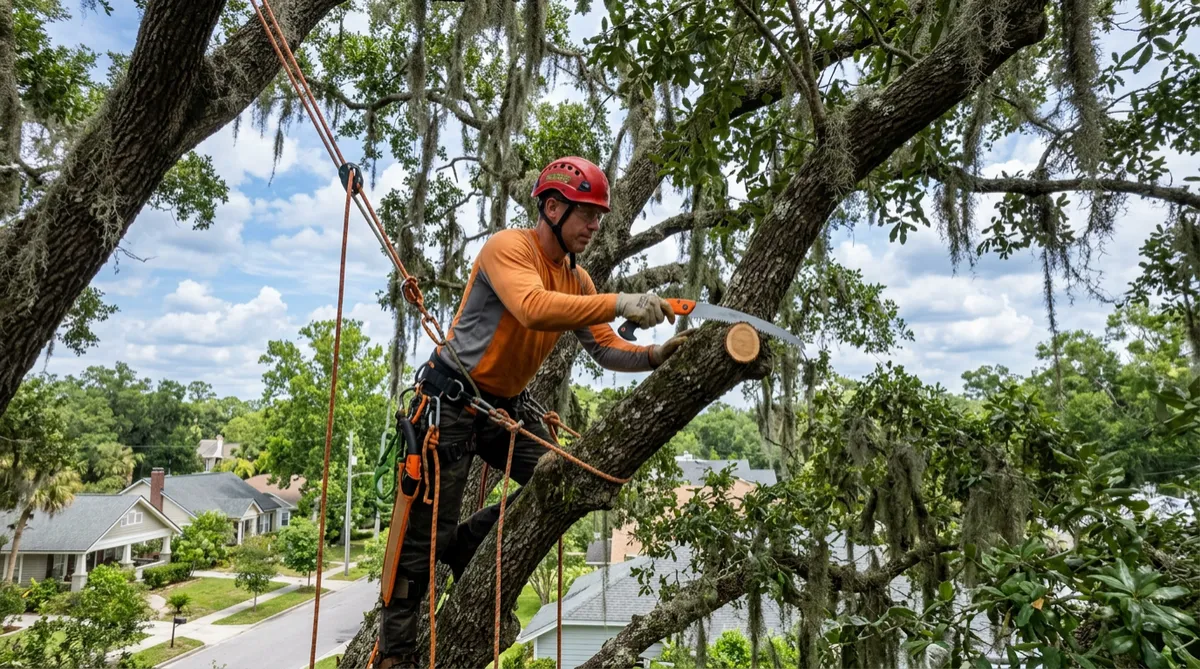
Tree Trimming & Pruning in Flagler and Volusia
Well-planned tree trimming can make a property safer, healthier and more inviting—but a hurried cut can do the opposite. In Flagler County and Volusia County, homeowners live with salt air, sandy soils, summer thunderstorms and the seasonal threat of tropical weather. The right pruning plan accounts for a tree’s species, age, structure and surroundings, not just the branches that look untidy. Whether your yard is near the Flagler Beach Pier, outside DeLand, or farther inland toward Interlachen and Putnam County, thoughtful care helps trees remain assets rather than avoidable hazards.
Pruning is not simply taking a saw to whatever hangs low. It is a series of selective cuts made for a clear reason: removing dead or damaged wood, improving structure, reducing a specific conflict or supporting long-term health. Knowing when to leave a tree alone is part of good care, too. This guide explains what homeowners should know before trimming, what work is best left to a professional, and how to make decisions that respect Florida trees and changing weather.
Why thoughtful pruning matters
Removing dead, broken or diseased branches can reduce the chance that they will fall during ordinary wind and rain. Selective pruning may also improve clearance over a driveway or walkway, reduce rubbing branches and help a young tree develop a balanced framework. For mature trees, the goal is usually modest maintenance: preserve the natural form, address a defined concern and avoid removing more living canopy than necessary.
Pruning can improve visibility around a driveway or sign and keep branches from brushing a roof, but it cannot make a tree storm-proof. Every tree has limits, and conditions such as decay, root damage or a poorly formed union may require an on-site assessment. Removing foliage without a plan can expose bark to sun, stress the tree and encourage weak regrowth. A good recommendation connects each proposed cut to a specific benefit and considers how the tree will respond over time.
Trimming, pruning and topping: what is the difference?
Pruning is selective; trimming often describes clearance
People use “trimming” and “pruning” interchangeably. In practice, pruning usually means selectively removing branches to manage a tree’s health, structure or safety, while trimming is often used for shaping shrubs or maintaining clearance. The name matters less than the method: cuts should be deliberate, appropriate for the species and limited to what is needed.
Why topping is not a shortcut
Topping cuts large branches back to stubs or removes the upper canopy without regard for natural branch structure. It leaves large wounds and can trigger clusters of fast-growing, weakly attached shoots. Those shoots may become more vulnerable to breakage, while the loss of foliage can stress the tree and spoil its form. Topping does not reliably solve height or storm concerns. If a tree has outgrown its space, ask a qualified arborist about suitable reduction pruning, ongoing management or whether removal should be considered. Never choose topping simply because it seems faster or cheaper.
Choosing a season in Florida—and preparing for hurricane season
There is no single best pruning date for every Florida tree. Dead, broken or hazardous branches can warrant prompt attention at any time, while routine work should account for species, flowering, nesting activity and local conditions. Many deciduous trees are easier to assess during a dormant period, but Florida’s mild winters and varied species make a calendar-only rule unreliable. Flowering trees may lose blooms if pruned at the wrong time, and palms have different maintenance needs from broadleaf trees. Ask for species-specific guidance before scheduling significant work.
Hurricane preparation is best handled well before a storm is forecast. Have trees assessed in advance, especially those with dead limbs, tight branch unions, visible decay or branches close to structures. A professional can identify maintenance needs while there is time to plan safely. Avoid heavy pruning immediately before storm season as a blanket measure: excessive canopy removal can stress a tree, and last-minute cuts cannot guarantee that it will withstand extreme winds. Never climb or cut during a storm, and keep away from downed limbs and wires.
Local conditions vary from coastal neighborhoods near Washington Oaks Gardens State Park and Flagler Beach to inland properties around Crescent Lake and the Ocala National Forest edge near Interlachen. Salt exposure, soil moisture, tree species and wind exposure all influence what maintenance makes sense. Residents near Bulow Plantation Ruins Historic State Park, Daytona International Speedway, Blue Spring State Park or DeLeon Springs may have very different yards, but the same principle applies: assess the individual tree rather than follow a one-size-fits-all schedule.
How proper cuts protect a tree
Find the branch collar
A branch attaches to the trunk or a larger limb at a junction that often shows a slight swelling called the branch collar. The collar contains tissue that helps the tree close over a wound. A proper removal cut is made just beyond the collar, preserving it; cutting flush against the trunk can damage that protective area, while leaving a long stub may slow closure. Do not coat routine pruning wounds with paint or sealant unless a qualified professional identifies a specific reason.
Use the three-cut method for larger limbs
A heavy limb can tear bark down the trunk if it is removed with one cut. The three-cut method helps prevent that: first make a small undercut a short distance out from the branch collar; next make a top cut farther out to remove most of the limb’s weight; then make the final cut just outside the collar. The first two cuts release the branch without stripping bark, and the final cut leaves the collar intact. This technique is for trained, equipped workers on manageable limbs—not a reason for a homeowner to work from a ladder or beneath a suspended branch. Large, high or tension-loaded limbs require professional equipment and judgment.

Consider the tree species before making a cut
Live oaks
Live oaks have broad, spreading canopies and strong landscape value. Avoid routine severe reduction or topping. A qualified arborist can assess deadwood, crossing limbs, roof clearance and branch structure while maintaining the tree’s natural form. If work is needed near a live oak, plan it carefully and confirm any local protections or permitting requirements that may apply to the property.
Palms
Palms are not pruned like shade trees. Remove only fully dead or clearly hazardous fronds when appropriate; cutting green fronds can weaken a palm and reduce its ability to produce food. Do not remove the growing tip, often called the spear, and do not strip a palm into a narrow “hurricane cut.” That practice does not make it storm-proof. A palm with a damaged crown or unusual symptoms should be assessed by a professional.
Crape myrtles
Crape myrtles need little pruning once established. Remove dead, damaged or crossing branches and, when needed, make careful structural cuts that preserve the plant’s natural branching. Repeatedly cutting every stem back to thick stubs—sometimes called “crape murder”—creates awkward knuckles and dense shoots, rather than a graceful canopy. Choose a variety suited to the planting space so repeated height reduction is not necessary.
Pines
Pines have their own growth pattern and do not respond to arbitrary cuts the way some broadleaf trees do. Removing too much foliage or cutting beyond the living growing tips may leave bare sections that do not refill. Prune for a specific reason, such as deadwood or a defined clearance issue, and get professional advice before altering a pine’s shape or height.

Power lines, roofs and other clearance concerns
Branches near electrical lines are not a do-it-yourself project. Keep people, ladders and tools away, and contact the electric utility or a qualified tree-care professional for direction. Never assume a line is safe because it appears insulated, and never try to pull a branch off a wire. If a branch has contacted a line or a wire is down, stay well clear and report the hazard to the utility or emergency services as appropriate.
For roof, driveway and walkway clearance, first decide what actually needs to be kept clear. A professional can recommend selective cuts that address a conflict without stripping the canopy or creating an imbalance. If a tree is near a public road, shared boundary or protected area, check applicable local requirements before work begins.
DIY or hire a certified, insured arborist?
Homeowners may be able to handle a small, reachable twig or a light shrub trim with suitable hand tools and protective equipment. Stop if a cut requires a ladder, chainsaw overhead, climbing, work near a structure or line, or handling a limb that could swing or fall unpredictably. Chainsaws and elevated work can cause serious injuries; a few minutes saved is not worth the risk.
For mature trees, large limbs, storm damage or work near a home, hire an arborist with relevant credentials and current insurance. Ask for proof of insurance, a written scope and an explanation of the cuts being proposed. Confirm that the plan is pruning—not topping—and ask how the crew will protect people and property. A trustworthy professional should welcome questions, identify limits and explain when no pruning is needed. In Flagler and Volusia counties, homeowners can use the same checklist whether they are near the coast, around DeLand or farther inland toward Interlachen and Putnam County.
Frequently Asked Questions
When should I prune trees in Flagler or Volusia County?
It depends on the species and the reason for pruning. Address hazardous dead or broken branches promptly when it is safe, and schedule routine work after a professional considers flowering, growth and local conditions. Do not rely on one calendar date for every tree.
Does pruning make a tree hurricane-proof?
No. Proper maintenance can remove some defects and reduce certain risks, but no pruning method can guarantee a tree will remain standing or prevent all damage in extreme weather. Arrange an assessment well before a storm is forecast.
How much of a tree can be removed at one time?
There is no safe universal percentage for every tree. The appropriate amount depends on species, condition, age, structure and the purpose of the work. Excessive live-canopy removal can stress a tree, so ask the arborist to explain the proposed scope.
Can I cut branches that touch a power line?
No. Keep away from the line, branch and nearby tools or ladders. Contact the electric utility or a qualified professional for direction; treat downed wires as dangerous and report them without approaching.
What should I ask before hiring a tree-care company?
Ask whether the arborist has relevant credentials and current insurance, what specific cuts are proposed, how the crew will protect the site and whether local approvals are needed. Request a written scope and avoid anyone who recommends topping as routine maintenance.
Healthy trees are worth careful decisions. If you have a tree that needs an assessment, clearance work or storm-season planning in Flagler County, Volusia County, Interlachen or Putnam County, contact Arborman Tree Services to discuss your needs and request a free estimate. Share the tree’s location and the concern you have, and the team can help determine an appropriate next step.
Website built by astreetgarage.com
