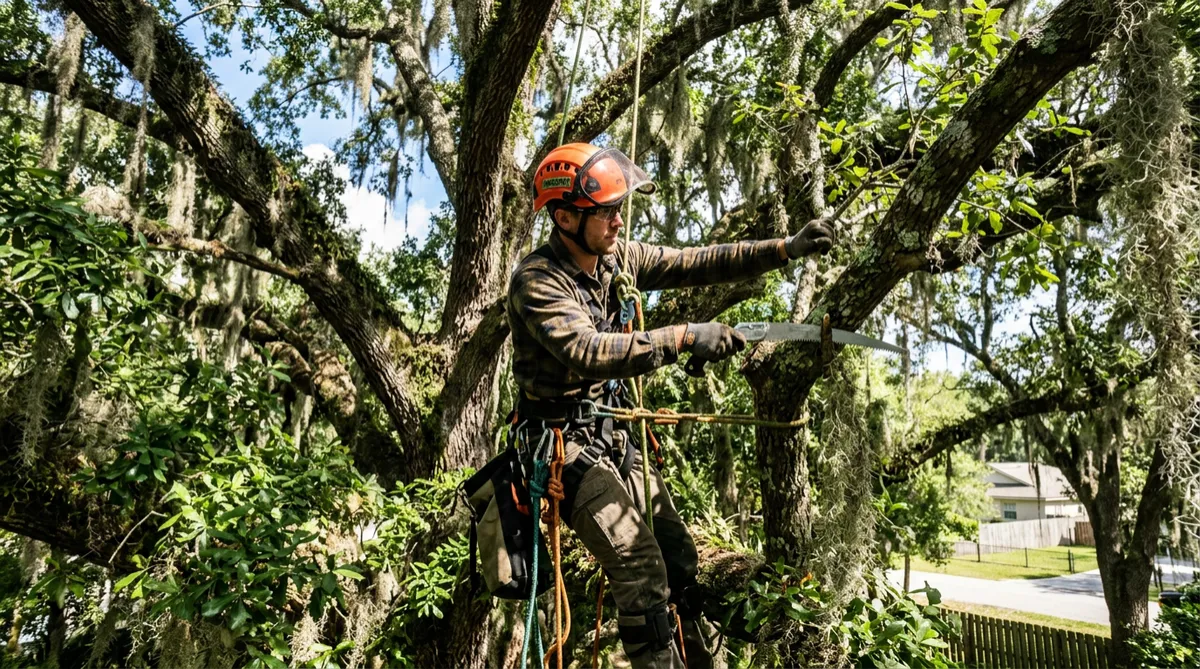
North Florida Tree Trimming & Pruning Guide
Thoughtful Tree Trimming and Pruning for North Florida Properties
In North Florida, a healthy tree is part of the home’s character: live oaks shade the yard, palms frame the entrance, and mature branches soften a street’s summer heat. Good tree care is not simply cutting back whatever looks overgrown. It means understanding how a tree grows, identifying what needs attention, and making selective cuts that protect its structure, health, and setting. For homeowners and property managers, a considered plan can improve clearance, remove damaged limbs, and help trees fit their surroundings without stripping away the canopy that makes them valuable.

From St. Augustine’s historic streets near Castillo de San Marcos and the Bridge of Lions to riverfront neighborhoods around Spring Park in Green Cove Springs, trees grow amid homes, sidewalks, roads, and overhead utilities. The right work depends on the species, season, condition, and site—not a one-size-fits-all trim. Here is how to think about trimming and pruning across St. Johns, Clay, Putnam, Flagler, and Volusia counties.
Trimming, pruning, thinning, reduction, and raising: what is the difference?
People often use “trimming” and “pruning” interchangeably. Trimming commonly means cutting back foliage or branches to improve appearance or keep growth within a space. Pruning is the more deliberate practice of removing selected branches for tree health, structure, safety, or clearance. A qualified professional should explain the objective before work begins, so the cuts support the tree rather than simply make it smaller.
Crown thinning selectively removes some smaller branches throughout the canopy to reduce density while preserving the tree’s natural outline. Proper thinning is balanced and modest; it is not stripping out interior growth or leaving a sparse shell of foliage. Crown reduction shortens selected limbs back to suitable lateral branches to reduce the canopy’s spread or height while retaining its form. It is not the same as topping, which indiscriminately cuts branches back to stubs and can create weak regrowth, large wounds, and lasting structural problems.
Crown raising removes or shortens lower branches to provide clearance for roofs, walkways, vehicles, signs, or sightlines. The amount removed should be limited and planned around the tree’s structure. A professional may recommend a combination of methods, or may advise against pruning if the proposed cuts would create more risk than benefit.
When to schedule tree work in North Florida
Many structural pruning jobs are easiest to plan during the dormant season, when deciduous trees have slowed growth and the branch framework is easier to see. In Florida’s mild climate, trees do not all follow the same schedule: evergreen live oaks retain leaves, palms grow differently from broadleaf trees, and local weather can shift timing. A tree’s species, condition, flowering cycle, and the reason for pruning should guide the calendar.
For live oaks, homeowners often hear seasonal caution because oak wilt is spread by insect vectors in regions where the disease occurs. UF/IFAS describes oak wilt as a potential future threat in Florida, rather than an established Florida disease. As a prudent general practice, avoid unnecessary heavy oak pruning during warm periods—especially spring and early summer, when beetle activity may be higher—and arrange essential work with a qualified arborist who can advise on timing and wound management. Do not delay urgent removal of an immediate hazard solely to wait for a season; get a professional assessment.
Storm preparation is best done well before a forecast or hurricane warning. Scheduling an inspection ahead of the Atlantic hurricane season allows time to identify deadwood, weak attachments, and branches that may need selective attention. Cutting trees during high winds or rushing into last-minute canopy work can create avoidable hazards. After a storm, stay clear of hanging limbs and downed trees, especially where electrical wires may be involved.
Live oaks, Spanish moss, and preserving a natural canopy
Live oaks are defining trees throughout Northeast Florida, from the grounds around the St. Augustine Lighthouse to established neighborhoods in Green Cove Springs and Palatka. Their broad, low-reaching limbs provide valuable shade and a strong sense of place, but their size calls for planning. Pruning should maintain sound branch structure, preserve well-spaced limbs, and account for the tree’s mature form—not force a spreading oak into a narrow, unnatural silhouette.
Spanish moss is an epiphyte that uses trees for support; its presence alone does not mean the oak is sick or needs to be stripped. Heavy growth can make a canopy look dense, and in some cases removing a limited amount may improve light or reduce weight on already vulnerable branches. But moss is not a substitute for diagnosing a problem: look for dead limbs, cracked unions, decay, or a sudden change in leaf condition. Avoid pulling or cutting indiscriminately through live branches. An arborist can distinguish normal moss from signs that deserve further assessment.
Where a reduction is appropriate, cuts should be made back to suitable lateral branches, not across the top of the crown. A mature oak may need several modest visits rather than one severe pruning. On protected or heritage trees, check applicable local rules before work begins. Careful decisions help retain the shade and character that make mature oaks so valuable.

Palm trimming without harmful hurricane cuts
Palm maintenance is different from pruning an oak or other broadleaf tree. Remove only fully dead or broken fronds and fruit or flower stalks when there is a practical reason, using clean tools and care around the trunk. Green fronds help a palm make food; removing healthy fronds can stress it and may slow growth. Do not cut fronds above the horizontal line simply to make a palm look narrow, and do not leave a small tuft of upright leaves in a so-called “hurricane cut.” That practice does not make a palm stormproof and can harm the plant.
Palms vary by species, and some naturally retain old fronds longer than others. If fronds are discolored or drooping, first consider whether the palm has a nutrient, water, pest, or disease issue; cutting symptoms away does not solve the cause. Work high above the ground should be left to trained professionals with appropriate equipment, rather than attempted from a ladder or by climbing the palm.
Roof clearance, power lines, and pre-storm canopy care
Branches touching a roof can abrade shingles, collect debris, and provide a path for animals; limbs over driveways, sidewalks, and parking areas can interfere with everyday use. Selective clearance pruning can help, but cutting too much from one side may unbalance a tree or expose interior branches to sun and wind. Ask for a plan that maintains natural form while creating the clearance the property actually needs. In coastal and inland settings alike, a routine inspection is more useful than severe pruning after growth has become a problem.
Before hurricane season, an arborist can look for deadwood, hanging limbs, cracks, poor attachments, and branches that may conflict with structures. Canopy thinning is not a promise against storm damage: the goal is to remove selected branches where appropriate while preserving healthy, well-spaced foliage. Heavy or indiscriminate thinning can weaken a tree and increase stress. Trees and limbs near power lines require special caution. Never prune near energized lines yourself; contact the utility or a qualified line-clearance professional for work in that zone.
Property owners in Flagler County, near Washington Oaks Gardens State Park or Flagler Beach, and in Volusia County around Blue Spring State Park or Daytona Beach may face different exposures than inland properties in Putnam County. Site conditions, tree species, soil, prior pruning, and nearby structures all matter. A local assessment helps put the work in context without treating every tree as a storm emergency.
Signs a tree may need attention—and how to choose an arborist
Schedule an evaluation if you notice a large dead limb, a fresh crack, a branch hanging unusually low, rubbing or crossing limbs, decay or cavities, a sudden lean, or roots lifting soil near the trunk. Pay attention after a lightning strike, vehicle impact, construction, or major storm. One symptom does not always mean a tree must be removed, and some cavities or moss may be harmless; a professional should assess the whole tree and its surroundings. If a tree is shifting, splitting, or threatening people or structures, keep away from the area and seek prompt help.
Ask who will inspect the tree and supervise the work, what specific cuts are proposed, and how the crew will protect people, buildings, and landscaping. Look for appropriate arborist credentials and verify them directly with the issuing organization; ask about insurance and request a written scope describing the trees, work, cleanup, and any exclusions. A sound recommendation should explain why each cut is needed and should not rely on topping, scare tactics, or guaranteed storm protection. For public trees or work in regulated areas, check local requirements before authorizing work.
Arborman Tree Services serves property owners and managers in St. Augustine, Green Cove Springs, Interlachen, Volusia County, Flagler County, St. Johns County, and Putnam County. Local landmarks—from Ravine Gardens State Park in Palatka to the St. Augustine Lighthouse—reflect the region’s mix of shaded neighborhoods, historic places, and coastal communities. Trees should be cared for with the same attention to their site and long-term structure.
Frequently Asked Questions
Is winter always the best time to prune a tree in North Florida?
Not always. The best timing depends on the tree species, the goal, and the tree’s condition; dormant-season work can make structure easier to assess, while palms and evergreens follow different patterns. For live oaks, avoid unnecessary heavy pruning during warm periods when feasible, and ask an arborist about the safest schedule.
Does Spanish moss mean my live oak is unhealthy?
No. Spanish moss grows on branches for support and is not, by itself, proof of disease or decline. Look for other signs—such as deadwood, cracks, or decay—and have concerning changes assessed rather than removing moss indiscriminately.
Can a tree be made hurricane-proof by thinning or trimming it?
No pruning method can guarantee that a tree will withstand a hurricane. Selective maintenance may address certain defects or conflicts, but severe thinning or topping can make a tree worse off. An inspection well before storm season can help identify reasonable steps without promising a particular outcome.
How much should be removed from a tree in one visit?
There is no single percentage that suits every tree, and the appropriate amount depends on species, health, structure, age, and the reason for the work. A professional should explain the intended cuts and avoid removing so much foliage that it compromises the tree’s balance or health.
Should I prune a branch that is near a power line?
No. Keep away from power lines and do not use a ladder, pole saw, or other tool near them. Contact the utility or a qualified line-clearance professional to determine the safe next step.
Thoughtful pruning protects the form and function of the trees that make North Florida properties distinctive. To discuss a tree at your home or managed property, contact Arborman Tree Services and describe the tree, its location, and the concern you have; the team can help determine what assessment or care may be appropriate.
Website built by astreetgarage.com
