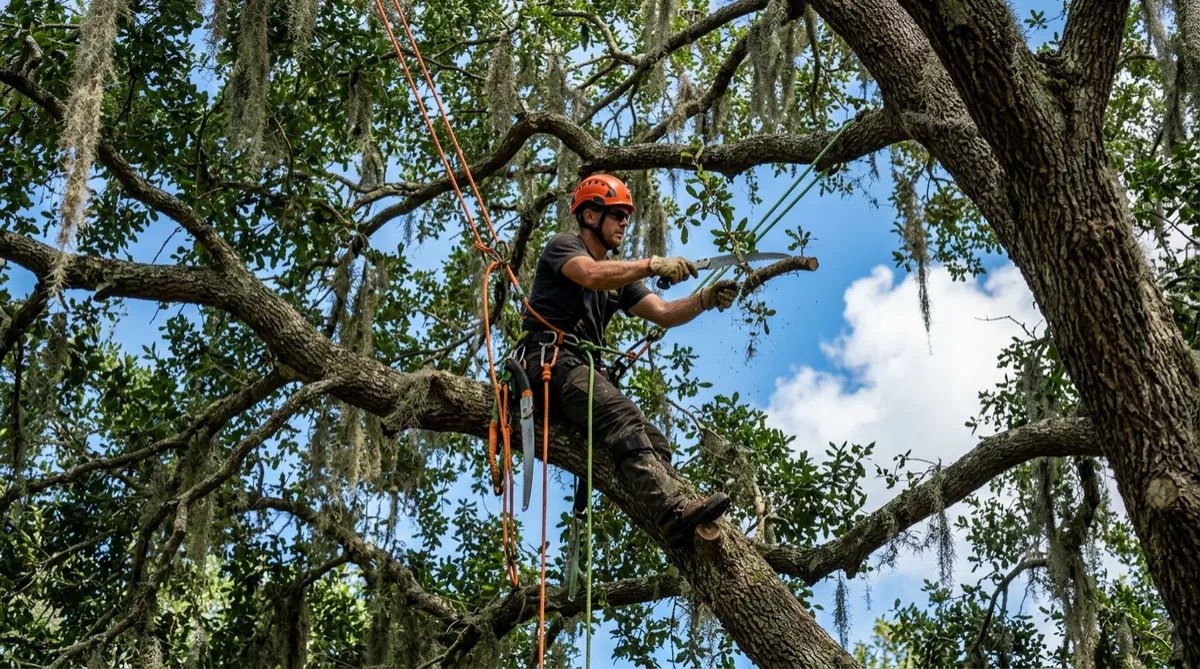
Tree Trimming & Pruning in North Florida | Arborman
Healthy trees bring shade, character, and value, but they can develop deadwood, crowded branches, or limbs too close to a roof or walkway. Thoughtful pruning addresses concerns while preserving natural form. In Green Cove Springs, Interlachen, and Putnam County, the right approach depends on the species, condition, season, and purpose—not simply how much can be cut.

Why prune a tree?
Pruning is the selective removal of branches. It can remove dead, damaged, diseased, or rubbing wood; improve a young tree’s structure; create needed clearance; and reduce a dense canopy where appropriate. The goal is not to make every tree look alike. A good pruning plan respects the tree’s natural growth habit and removes only what serves a clear purpose.
Removing a broken or declining branch can help limit hazards and may reduce the spread of some pests or disease, depending on the cause. Structural pruning can encourage a stronger framework as a tree grows. Clearance pruning can keep branches from contacting a building, blocking a path, or interfering with a driveway. Pruning is not a cure-all, however. A tree with extensive decay, root damage, or serious structural defects may need an assessment beyond routine trimming.
More cutting is not automatically better. Excessive removal can stress a tree, expose bark and limbs to harsh sun, and prompt weak, fast-growing shoots. Before work begins, decide what problem you are solving and whether pruning is the right response.
Choosing the right kind of pruning
Crown thinning
Crown thinning selectively removes a limited number of smaller branches through the canopy to reduce crowding while retaining the tree’s overall shape and size. It should not leave a tree sparse or stripped. A well-considered thinning plan preserves an even distribution of foliage and avoids creating large openings that can expose interior limbs to sudden sunlight and wind.
Crown raising
Crown raising removes or shortens lower branches to provide clearance beneath the canopy. It may be useful over a walkway, driveway, or lawn area, but removing too many lower limbs at once can shift the tree’s balance and reduce its ability to form a strong trunk. A qualified professional can set a gradual plan, especially for a mature tree.
Crown reduction
Crown reduction decreases a tree’s height or spread by cutting selected branches back to suitable lateral branches. It is not the same as topping. Proper reduction retains a natural outline and directs growth to branches capable of taking over. If a tree has outgrown its space, discuss whether careful reduction, relocation while young, or another solution is appropriate.
Why topping and “crape murder” cause problems
Topping cuts back large limbs to stubs or indiscriminately shortens the top of a tree. This practice removes much of the leaf-producing crown, leaves large wounds, and often triggers clusters of weakly attached shoots. Those shoots can become hazardous as they grow. The tree may also look unnatural and require repeated corrective work. Topping is not a reliable way to make a tree safer or permanently smaller.
“Crape murder” is the common name for repeatedly cutting crape myrtles back to thick stubs. It is unnecessary for healthy trees and can produce vigorous, crowded shoots while spoiling the plant’s natural branching and graceful form. Crape myrtles can be lightly shaped by removing dead, crossing, or poorly placed growth and, when needed, making selective cuts that preserve the plant’s structure. Choose a variety suited to the available space rather than relying on severe annual cutting to control its size.
When to prune in North Florida
There is no single calendar date that suits every tree. In North Florida, many routine pruning jobs can be planned during the cooler, drier part of the year, when the tree’s growth is slower and work may be easier to schedule. Flowering trees need species-specific timing: pruning at the wrong point in their cycle can remove developing flowers. Some trees are best pruned after flowering, while others tolerate dormant-season pruning. A local arborist can identify the species and recommend timing for the objective.
Dead, broken, or hazardous branches may need attention whenever they are discovered; do not leave an immediate safety concern in place merely to wait for an ideal season. On the other hand, avoid heavy, unnecessary pruning right before hurricane season. Severe cutting can leave a tree stressed and does not guarantee that it will withstand a storm. Before storm season, focus on a professional inspection and selective removal of deadwood, weak attachments, and other identifiable concerns. Never prune during a storm or when branches are in contact with power lines.
Green Cove Springs’ historic Spring Park and St. Johns River waterfront, Lake Interlachen, and the Ocala National Forest edge are distinct local settings; each tree still needs an individual assessment.
Make the cut correctly
For an appropriate branch that is within reach and safe to handle, a proper cut protects the branch collar—the slightly enlarged area where a branch joins its parent limb or trunk. The collar contains tissue that helps the tree close over a wound. Cutting flush against the trunk damages this area, while leaving a long stub can slow closure and invite decay. A clean cut just outside the collar is generally the objective; do not coat a routine pruning wound with paint or sealant unless a qualified specialist advises otherwise for a specific reason.
Large or heavy branches should be removed with the three-cut method to reduce bark tearing. First, make a small undercut a short distance out from the collar. Next, make a top cut farther out, beyond the first cut, so the branch’s weight breaks away without stripping bark down the trunk. Finally, remove the remaining stub with a careful cut just outside the branch collar. This method is for trained, safe work: large limbs can fall, shift, or spring under tension. Homeowners should not attempt cuts that require climbing, a ladder, a chainsaw overhead, or working near energized lines.

Young trees benefit from early structural care
Pruning a young tree can help establish a stable framework before competing stems and poorly placed branches become large. A professional may identify a dominant central leader where appropriate, address crossing or rubbing branches, and space major limbs sensibly along the trunk. The aim is gradual development, not an aggressively thinned crown. A young tree usually needs only modest, purposeful cuts, and its species and intended mature size matter.
Live oaks and palms need species-aware care
Live oaks are important shade trees across North Florida. Their broad canopies and substantial limbs call for careful assessment, sound cuts, and respect for their natural form. Avoid stripping the interior or removing large limbs simply to create an arbitrary shape. A certified arborist can evaluate branch unions, deadwood, clearance needs, and the tree’s overall structure before recommending work. Local requirements may also apply to certain trees or properties; check with the relevant local authority when you are unsure.
Palm care differs from broadleaf tree pruning. Remove only fully dead or damaged fronds when appropriate, and avoid cutting green fronds for appearance or removing the palm’s growing point. Over-pruning can weaken a palm and leave it more vulnerable to stress. Do not pull or cut fruit stalks or fronds from a position that puts you beneath falling material. If you are uncertain about the palm species, its condition, or safe access, consult a professional familiar with palm care.
Warning signs that a limb may be dangerous
- A large dead or hanging branch, especially one over a roof, driveway, or place people use.
- A fresh crack, split, or opening where a major limb joins the trunk.
- Branches that have begun to sag suddenly, move abnormally, or show fresh breakage.
- Visible decay, cavities, or fungal growth near a major branch union, particularly alongside other signs of decline.
- Repeated rubbing between limbs, a damaged attachment, or a branch that has shifted after wind.
These signs do not prove that a branch will fail, but they warrant prompt attention. Keep people and vehicles away from the area if something appears unstable, and contact a qualified tree professional. If a limb is touching or threatening a power line, stay well clear and contact the utility. Tree workers should not handle energized electrical conductors; only the utility or properly qualified line-clearance professionals should address that hazard.
Safety, equipment, and choosing a professional
Tree work involves sharp tools, heavy wood, overhead hazards, and unpredictable movement. A homeowner trimming a small, stable branch from the ground should use sharp, appropriate pruning tools, eye protection, gloves, and a clear work area. Do not work from a ladder while holding a saw, do not use a chainsaw above shoulder height, and do not trim near electrical wires. Leave climbing, large limbs, storm-damaged trees, and work requiring specialized equipment to trained professionals.
For larger jobs, ask whether the person assessing the tree is a certified arborist and whether the crew has appropriate training, insurance, and safety procedures. Request a written description of the work before it starts. A useful plan identifies which branches will be removed and why, preserves the tree’s natural form, and avoids topping and unnecessary over-pruning. Be wary of anyone who recommends severe cutting without explaining the tree’s condition and the intended outcome. If your property is near the Rodman area, Crescent Lake, Palatka, or the St. Johns River, share relevant access, shoreline, and neighboring-tree concerns during the site discussion.
Where we work
Arborman Tree Services serves homeowners across North and Northeast Florida, including Green Cove Springs, Interlachen, St Augustine, and communities in Volusia County, Flagler County, St Johns County, and Putnam County. Each property is different, so recommendations should be based on the species, tree condition, available space, and the work area—not a one-size-fits-all trimming schedule.
Frequently Asked Questions
When is the best time to prune trees in North Florida?
Timing depends on the tree species, its flowering cycle, and the reason for pruning. Many routine jobs can be planned for the cooler part of the year, but dead or dangerous branches may need attention sooner. Avoid heavy, unnecessary pruning just before hurricane season, and ask a local arborist about the right timing for your particular tree.
Can pruning make a tree hurricane-proof?
No pruning method can guarantee that a tree will withstand a hurricane. A professional can identify and address certain concerns, such as deadwood, weakly attached branches, or conflicts with a structure, but storms can damage even healthy trees. Avoid topping and severe pre-storm cutting; seek an assessment and follow sound, species-appropriate maintenance.
What is the difference between pruning and topping?
Pruning selectively removes branches for a defined purpose while preserving the tree’s natural structure. Topping cuts large limbs or the upper crown back indiscriminately, often leaving stubs and prompting weakly attached shoots. If a tree needs to be smaller, ask whether careful crown reduction is appropriate instead.
Should I remove green palm fronds?
Generally, healthy green fronds should remain. Removing them for appearance can deprive a palm of useful foliage, and cutting into its growing point can be fatal. Palm pruning needs to be limited and species-aware; leave high or difficult work to a professional.
When should I call a professional to prune a tree?
Call a qualified tree professional for climbing, large or heavy branches, storm damage, work near buildings, suspected structural defects, or any job involving a ladder or chainsaw. Stay far from power lines and call the utility if a branch touches or threatens them. For a free estimate, contact Arborman Tree Services and describe the tree and the concern.
For careful, tree-specific trimming and pruning in Green Cove Springs, Interlachen, Putnam County, and nearby communities, contact Arborman Tree Services for a free estimate. Share what you have noticed and where the tree is located so the team can discuss an appropriate next step.
Website built by astreetgarage.com
