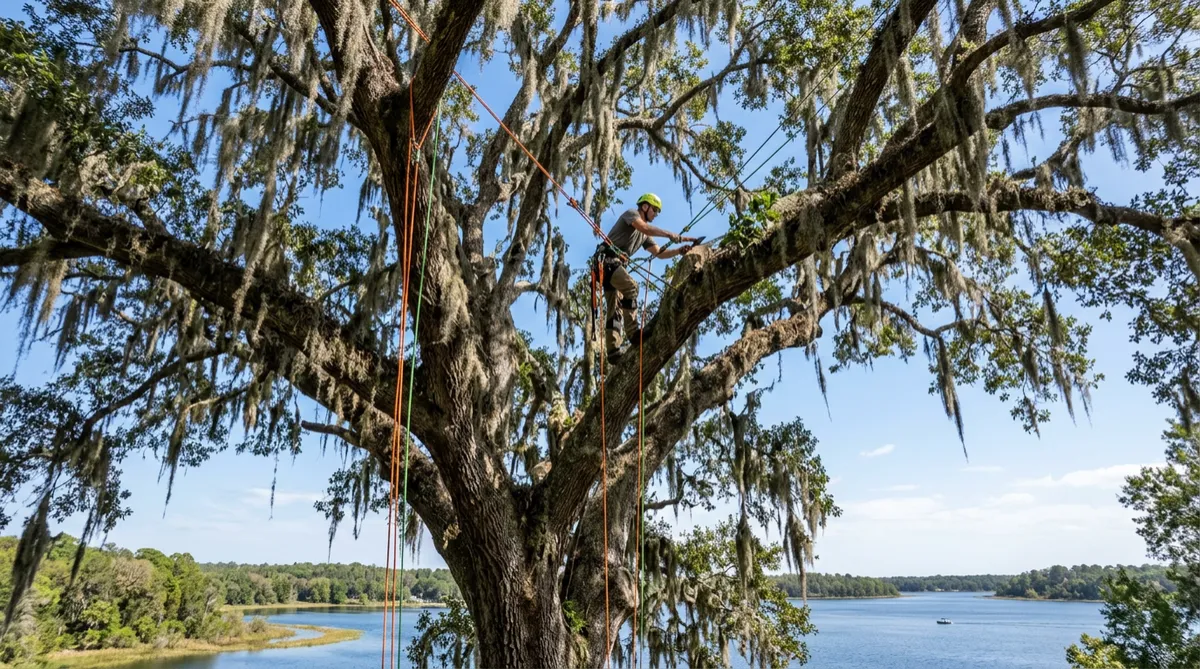
Tree Trimming & Pruning in Northeast Florida: A Homeowner’s Guide
Tree trimming is more than a way to tidy a yard. Thoughtful pruning can improve a tree’s structure, remove dead or hazardous limbs, preserve useful clearance, and help homeowners make informed decisions before severe weather arrives. In Northeast Florida, timing and technique matter: a live oak in Palatka, a pine near Interlachen, and a palm in Green Cove Springs do not all call for the same approach.

Why tree trimming matters in Northeast Florida
Our region’s long growing season, heat, humidity, heavy rain, and periodic tropical weather all affect how trees grow and how their branches respond to stress. A good pruning plan starts with the tree’s species, age, condition, location, and purpose—not simply with a desire to cut back everything that looks untidy.
In Palatka, mature trees are part of the character of neighborhoods near Ravine Gardens State Park and the St. Johns River. Around Interlachen, properties near Crescent Lake and the Lake Brooklyn area may have different soil, exposure, and space considerations. In Green Cove Springs, trees around Spring Park and older residential streets may need thoughtful clearance while retaining their shade and form. Every yard is different, so a site assessment is more useful than a one-size-fits-all trimming schedule.
Pruning has a purpose
Common objectives include removing dead, damaged, diseased, crossing, or poorly attached branches; creating clearance over a roof, walkway, or driveway; and reducing selected branch weight where appropriate. Pruning can also improve a tree’s structure while it is young. It cannot make a tree storm-proof, eliminate every risk, or compensate for root damage and poor site conditions.
When to prune trees in North Florida
For many deciduous trees, late fall and winter dormancy can be a practical time for structural pruning because the branch framework is easier to see and growth is slower. However, the best timing depends on species, health, flowering, and the reason for pruning. Some trees are better pruned after flowering; removing buds at the wrong time can reduce the next display. Dead or broken limbs and urgent hazards should be assessed promptly rather than left in place just to wait for a particular season.
North Florida homeowners sometimes feel pressure to cut back heavily as hurricane season approaches. A last-minute, aggressive prune is not a substitute for a thoughtful plan. Large cuts can create wounds and stress, and removing too much foliage can weaken a tree. Consider an evaluation well ahead of storm season, then prioritize deadwood, defects, and appropriate clearance. Routine maintenance is safer and more predictable than hurried, severe cutting.
Species-specific care
- Live oaks and laurel oaks: Keep their natural structure in mind. Selective removal of dead, damaged, or conflicting branches is preferable to indiscriminate canopy reduction. Large limbs deserve careful assessment, especially over homes or areas people use.
- Crape myrtles: Avoid “crape murder”—severely cutting back the tops year after year. That practice can leave large wounds and awkward regrowth. Prune lightly for deadwood, crossing stems, or necessary clearance, while allowing the plant’s natural form to show.
- Palms: Remove only dead or clearly damaged fronds and fruit or flower stalks when appropriate. Green fronds help support the palm. Over-pruning, removing the growing tip, or cutting into the trunk can seriously harm it.
- Pines: Pines generally do not respond to random heading cuts the way some broadleaf trees might. Dead or hazardous branches should be evaluated, and structural work should account for the species and branch arrangement.
Common pruning services and what they do
Ask a tree-care professional to explain the objective of each recommended cut. Useful terms describe different outcomes, not interchangeable ways to shorten a tree.
- Crown thinning selectively removes certain branches to improve spacing and light penetration while preserving the tree’s overall shape. It is not “lion-tailing,” the harmful practice of stripping inner branches and leaving foliage only at the ends.
- Crown raising removes or shortens selected lower branches to improve clearance over a walkway, road, or lawn. It should be gradual; taking too many lower limbs at once can leave the tree unbalanced.
- Deadwooding removes dead, broken, or dying branches that could fall. The amount and urgency depend on where those branches are and how people use the area below.
- Clearance pruning addresses branches near structures, vehicles, or access routes. Clearance should be achieved with suitable cuts, not by shearing a tree into an unnatural shape.
Branches touching or close to power lines are a special hazard. Do not climb, cut, or use a ladder or pole tool near electrical wires. Contact the utility to report the concern and ask about the appropriate response. Utility-line work requires specialized training and procedures.

Good technique protects the tree
Where a limb is too large to remove in one cut, a trained worker may use the three-cut method to reduce the chance of bark tearing. The first cut is made on the underside of the branch, a short distance out from the trunk. A second cut farther out removes the limb’s weight. The final cut removes the remaining stub just beyond the branch collar, the slightly enlarged area where the branch joins the trunk. The collar should not be cut flush, and a long stub should not be left behind.
Correct cut placement matters because trees compartmentalize injuries rather than healing them like skin. Large wounds, poor cuts, and unnecessary removal of live branches can increase stress and create opportunities for decay. Avoid topping: cutting back major limbs to stubs or indiscriminately reducing the height destroys the natural crown, encourages weakly attached shoots, and can lead to costly repeated work. If a tree is too large for its location, ask about options such as selective reduction where suitable, or whether removal should be considered.
Equipment and work practices matter too. A homeowner should not attempt work that involves climbing, chainsaws at height, heavy limbs, unstable trees, or nearby wires. A qualified crew should assess hazards, plan how limbs will be lowered, and protect people and property below.
Signs a tree may need attention
Look for dead branches, limbs that are cracked or hanging, rubbing branches, sudden changes in the canopy, visible decay, or branches interfering with a roof, driveway, or pedestrian route. After a storm, check from a safe distance for hanging limbs, a newly leaning tree, lifted soil, or damage where a major branch joins the trunk. Do not stand beneath a damaged canopy or try to remove a suspended limb yourself. Keep people away and seek a professional assessment.
Some concerns are less obvious. A fuller canopy does not necessarily mean a tree is healthy, and a few dead twigs do not by themselves prove that a whole tree is failing. Roots, trunk condition, branch attachments, recent construction, drainage, and the tree’s surroundings all help determine what is happening. For trees along the Welaka and Ocala National Forest edge, as well as properties throughout Putnam and Clay counties, local conditions and the specific site should guide decisions—not a generic checklist alone.
DIY trimming or a professional tree service?
Light pruning of small, reachable plants may be manageable for a homeowner using clean, sharp hand tools and sound judgment. Stop if the branch is larger than you can control, requires a ladder, is under tension, or is near a building, road, or utility line. Never use a chainsaw from a ladder or climb into a tree with cutting equipment. The risk rises quickly when limbs are heavy, the tree is damaged, or a cut could change the balance of the canopy.
For substantial tree work, ask a service to explain the work plan, the reason for each major cut, how the crew will manage hazards, and whether cleanup is included. Verify that the business has appropriate insurance and ask for documentation. Seek a written estimate that describes the scope rather than accepting a vague promise to “trim everything.” A reputable professional should be willing to discuss alternatives, preserve the tree’s natural form where practical, and decline unsafe work near energized lines.
When evaluating advice, look for a clear assessment and recommendations consistent with generally recognized arboricultural practices: remove only what is needed, make proper branch-collar cuts, avoid topping, and consider the species and condition. Be cautious of anyone proposing severe pruning without explaining why, or urging an immediate decision without a safety reason. Arborman Tree Services can discuss the condition of your trees and the work that may be appropriate for your property.
Frequently Asked Questions
How often should trees be trimmed in Northeast Florida?
There is no single schedule for every tree. Species, age, health, growth, and nearby targets all matter. Have trees assessed when you notice a change or concern, and avoid unnecessary routine cutting.
Is winter the best time to prune?
Late fall or winter dormancy can suit structural pruning for many deciduous species, but timing varies. Flowering trees, palms, pines, and urgent damaged limbs may need a different approach. Ask for species-specific guidance.
Should I top my tree before hurricane season?
No. Topping removes large portions of the crown, can create weak regrowth, and may make future care more difficult. Plan ahead and ask about selective, appropriate pruning instead; no pruning method can guarantee storm safety.
Can I trim branches near power lines myself?
No. Keep away from the wires, the tree, and any tools that could reach them. Contact the utility and follow its instructions; never attempt do-it-yourself work near electrical lines.
What should I ask before hiring a tree service?
Ask what work is recommended and why, how the crew will protect people and property, whether the estimate includes cleanup, and whether the company can provide proof of appropriate insurance. A clear, written scope helps you compare the proposed work and understand what to expect.
Make a thoughtful plan for your trees
Good tree trimming is selective, species-aware, and focused on a clear purpose. Whether you have a mature oak near the St. Johns River in Palatka, pines and palms around Interlachen, or crape myrtles in Green Cove Springs, careful decisions can preserve shade and structure while addressing practical concerns. If you see a hazard or want to plan maintenance before storm season, contact Arborman Tree Services today for a free estimate. We’ll help you understand the options for your trees and property.
Website built by astreetgarage.com
