Tree Trimming and Pruning in Northeast Florida: A Homeowner’s Guide
Tree Trimming and Pruning in Northeast Florida: A Homeowner’s Guide
Well-planned pruning can help a tree keep a strong structure, clear a roof or walkway, and remain a beautiful part of your yard. But trimming is not simply cutting away whatever looks untidy. The right approach depends on the tree’s species, age, condition, and location—and large or overhead work calls for trained professionals. In Northeast Florida, thoughtful maintenance before storm season can help address weak or conflicting growth without stripping away the canopy that gives a tree strength.

Why prune a tree?
Pruning is selective removal or shortening of branches for a clear purpose. It can remove dead, damaged, diseased, rubbing, or poorly attached limbs; improve clearance over a driveway or roof; and help a young tree develop a balanced framework. Removing a hazardous branch can reduce the chance that it will fall, while carefully managing competing stems can help a tree develop a sounder structure over time.
Pruning also has limits. It cannot make a tree storm-proof, correct every root or trunk defect, or guarantee that no limb will fail. A mature tree’s canopy provides shade, habitat, and visual character. Removing too much foliage at once can stress the tree and leave it less able to function. Before cutting, identify the issue you want to solve and consider whether a light, targeted cut—or an arborist’s assessment—is the safer answer.
When is the best time to trim trees in Florida?
There is no single calendar date that suits every Florida tree. Timing depends on the species, its flowering cycle, the reason for pruning, and the tree’s condition. Light pruning to remove a broken or clearly dead branch may be needed whenever it is noticed, provided the work is safe. For flowering trees, timing can affect next season’s blooms: a tree that flowers on older growth may need attention after flowering, while one that blooms on new growth is often pruned during dormancy or before spring growth begins. When you do not know the species or its cycle, ask an arborist before making a substantial cut.
For Northeast Florida homeowners, plan structural maintenance well ahead of the storm season rather than waiting until a storm is forecast. A professional inspection can identify deadwood, cracks, long or weak limbs, low branches near a roof, or stems competing with the main trunk. Scheduling early gives time to discuss a measured plan and complete work before emergency demand rises. A healthy tree should not be aggressively “storm trimmed” at the last minute; good structure is developed gradually through proper pruning over time.

Good cuts protect the tree; topping does not
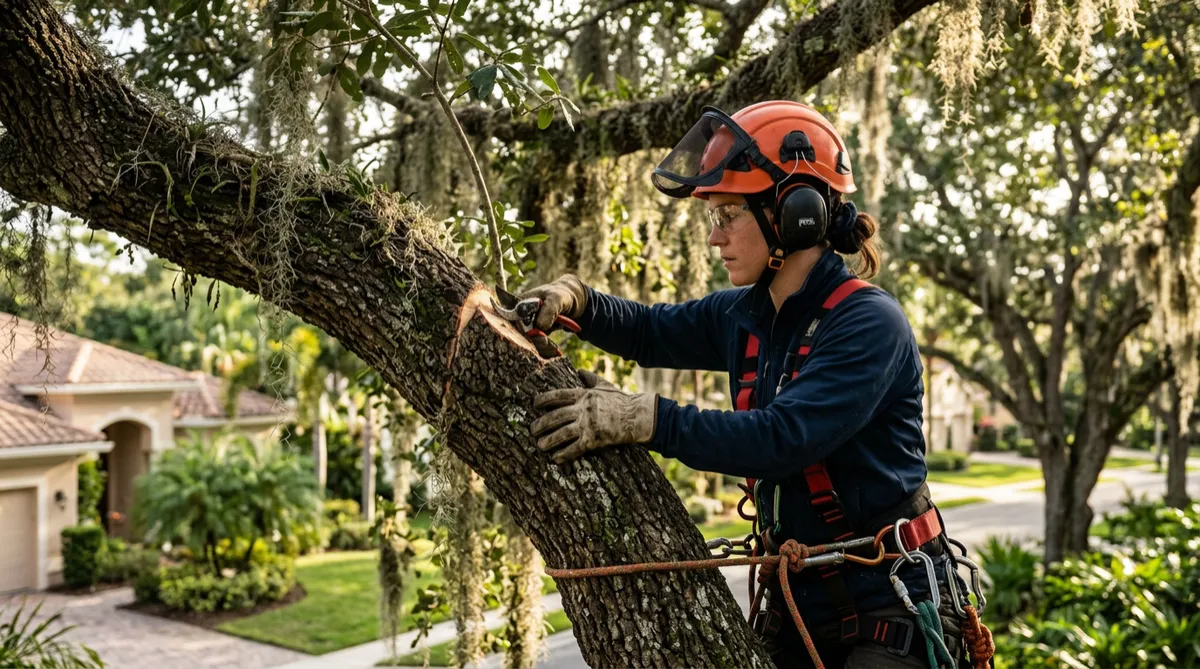
A proper branch cut respects the branch collar, the slightly swollen area where a limb joins its parent branch or trunk. A trained pruner generally cuts just beyond that collar without leaving a long stub or cutting flush into the trunk. The collar and adjacent tissues help the tree compartmentalize a wound. For a heavy limb, a professional may use a sequence of cuts to keep its weight from tearing bark as it comes down. That work requires the right equipment and experience; homeowners should not try to manage large limbs from a ladder.
Topping is the indiscriminate shortening of a tree by cutting back large limbs to stubs. It is not a sound way to make a tree safer or control its size. The cuts create large wounds, spoil the tree’s natural framework, and can prompt dense, weakly attached shoots that need repeated attention. Topping may also leave a tree looking abruptly bare without resolving the underlying concern. If a tree has outgrown its space, ask about a carefully planned reduction—or whether a different solution is needed—instead of accepting a proposal to top it.
Four common pruning goals
Cleaning: remove what is damaged
Cleaning focuses on dead, dying, diseased, broken, or rubbing branches. It is often a sensible first step in a maintenance plan, but “cleaning” should not become an excuse to strip healthy interior growth. A careful assessment distinguishes an unhealthy branch from one that simply looks irregular.
Thinning: improve spacing while keeping a natural crown
Crown thinning selectively removes branches to improve spacing and reduce congestion while preserving the overall shape and foliage across the canopy. The aim is not to hollow out the tree or remove every interior branch. Over-thinning and “lion-tailing”—leaving foliage only at the ends of long limbs—can create an unnatural structure and shift loads in ways that are not helpful. A qualified arborist chooses which branches to remove and how much foliage to retain.
Raising: create clearance below the canopy
Crown raising removes or shortens lower branches to provide practical clearance for people, vehicles, paths, or buildings. Done gradually, it can make a yard easier to use while maintaining a balanced tree. Removing too many lower limbs at once, or lifting a mature canopy excessively, can leave the tree top-heavy and change its structure. Tell the arborist what needs clearance and let the plan preserve as much healthy canopy as possible.
Reduction: manage size with appropriate cuts
Crown reduction decreases the height or spread of a tree by shortening selected branches back to suitable lateral branches. It is different from topping: cuts should follow the tree’s structure and leave a natural outline. Reduction is not appropriate for every tree, and large reductions may increase stress or future maintenance. A professional should explain the objective, how much canopy will be removed, and whether another option—such as selective clearance pruning—would better meet your need.
Live oaks, Spanish moss, and palms
Live oaks are familiar shade trees across the region, and a mature oak deserves a conservative hand. Pruning young oaks to establish a strong central structure can help guide future form; on older trees, focus on a specific concern such as deadwood, a damaged limb, or needed clearance. Spanish moss growing on an oak is not, by itself, proof that the tree is unhealthy: moss uses the tree for support rather than drawing nourishment from it. If heavy growth hangs from a weak or damaged limb, have the branch assessed instead of pulling moss down and risking injury or bark damage.
Palms need a different approach from broadleaf trees. Remove only fully brown, dead fronds when they are a hazard or need attention. Green fronds help the palm make food and should not be removed just to create a tightly clipped appearance. “Hurricane-cut” palms—those stripped of most of their fronds—are not better prepared for wind; over-pruning can weaken them. Avoid climbing spikes, which wound the trunk, and do not try to reach high fronds with a ladder. Fruit clusters that could fall may also merit professional attention.
Signs your tree may need attention
Look for dead or hanging branches, fresh cracks, limbs rubbing or resting on a roof, a new lean, a split between large stems, decay, sparse foliage, or disturbed roots. None automatically means a tree must come down, but a defect above a home, driveway, or well-used area deserves prompt attention.
Observe from the ground; do not climb, cut large limbs, or try to diagnose stability. An arborist can consider the species, structure, root zone, nearby targets, and history before recommending pruning, monitoring, or another option.
Power lines and pruning safety
Never prune a tree touching or close to power lines, or use a ladder or pole saw near wires. Branches and equipment can conduct electricity, and a line may be energized even if it looks harmless. Keep clear and contact the electric utility. Only the utility or its authorized line-clearance professionals should work near energized lines.
For other elevated or heavy work, use an insured professional with suitable training and equipment. Keep people and pets out of the work zone and away from suspended limbs. Falling wood, height, and sharp tools make even a seemingly small job hazardous.
How to choose a qualified arborist
Ask whether the person directing the work holds current arborist certification from a recognized professional organization, and verify the credential. Request proof of insurance, including workers’ compensation where applicable. Get a written proposal explaining the tree, purpose and extent of each cut, cleanup, and exclusions.
For significant work, consider another opinion—especially if someone recommends topping or removal without explaining why. A careful professional should describe alternatives and avoid promising that pruning eliminates storm risk. Ask about permits or neighborhood rules for protected trees or work near a public right-of-way.
Local tree care, from St. Augustine to Putnam County
In St. Augustine, a yard near the Bridge of Lions or Flagler College may need clearance planning around buildings, walks, and established trees. In Green Cove Springs and Interlachen, homeowners may be managing shade trees near driveways and open lots. Across St. Johns, Putnam, Flagler, and Volusia counties, let each tree’s species, condition, and surroundings—not a one-size-fits-all calendar—guide the plan.
Start by identifying the need: storm-season preparation, dead branches, roof clearance, or palm maintenance. A site-specific assessment can distinguish routine trimming from a concern needing prompt attention. The goal is a healthy tree with a natural crown, not a bare silhouette or a promise that no storm can cause damage.
Frequently Asked Questions
Should I trim my trees every year?
Not necessarily. Pruning needs vary by species, age, condition, and location. Have a specific reason for each cut, and ask an arborist whether routine monitoring or selective maintenance is appropriate.
Is late winter always the best time to prune in Florida?
No. Timing depends on the tree and the purpose of the work. Flowering cycles matter, and storm preparation should be planned well before seasonal storms rather than rushed at the last minute.
Does Spanish moss hurt a live oak?
Spanish moss is an epiphyte, not a parasite, and its presence alone does not mean an oak is unhealthy. Have weak, declining, or heavily burdened branches evaluated instead of pulling moss down yourself.
Will a hurricane cut make my palm safer?
No. Removing most of a palm’s green fronds can harm its health and is not a reliable storm-preparation method. Limit pruning to fully brown fronds and call a professional for high or hazardous work.
What should I do if a branch is near a power line?
Do not touch or prune it, and keep people away from the area. Contact your electric utility for instructions; only the utility or its authorized line-clearance professionals should handle work near energized lines.
Plan your next trim
For a tree-pruning assessment or a free estimate, contact Arborman Tree Services. Share the tree’s location and what you have noticed so the team can discuss an appropriate next step.
Website built by astreetgarage.com

