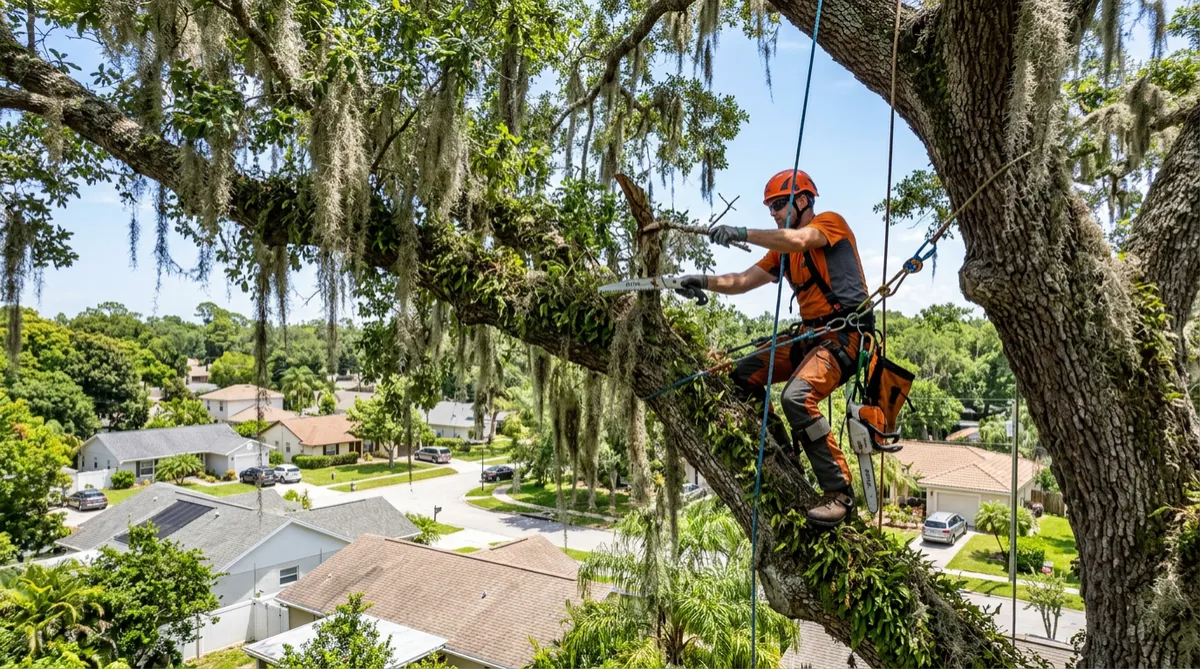
Tree Trimming & Pruning in Putnam and Flagler Counties: A North Florida Homeowner’s Guide
A healthy shade tree is part of what makes a North Florida yard feel like home. A broad live oak can cool a driveway, frame a view, and shelter a garden, but crowded, damaged, or poorly placed branches may eventually need attention. The aim of good tree care is not to make every canopy look alike. It is to keep the tree’s natural structure while addressing a specific concern—such as a broken limb, clearance over a roof, or a branch that is growing into a more important one.
For homeowners in Putnam County, from Interlachen to Palatka, and across Flagler County, choosing the right work and timing matters. North Florida’s warm, humid climate, strong summer storms, and mature oaks all call for thoughtful decisions. Here is how to tell trimming from pruning, what responsible work looks like, and when it makes sense to call Arborman Tree Services.

Tree trimming and pruning: what is the difference?
People often use “trimming” and “pruning” to mean the same thing, and the work can overlap. Trimming commonly describes shaping or clearing branches to improve appearance or maintain space around a roof, walkway, driveway, or sign. Pruning is the more specific practice of selectively removing branches to support a tree’s structure, health, or safety. The distinction is useful, but the reason for each cut matters more than the label.
Good work starts with a goal. A tree may need a dead limb removed, a crossing branch reduced, or a little clearance—not a drastic reshaping. Before cutting, consider the tree’s species, age, condition, growth pattern, and surroundings. A sound plan removes only what is needed and keeps as much healthy canopy as practical. Cutting for a quick visual effect can leave lasting damage.
When should North Florida trees be pruned?
There is no single calendar date that fits every tree or every job. For many trees, selective pruning during a cooler, less active growth period can make planning and inspection easier. Oaks deserve extra care: avoid treating winter as an automatic green light or assuming that every oak has the same dormant period. Live oaks keep their leaves for much of the year, and oak-wilt risk depends on local conditions and disease vectors, not simply whether a tree looks dormant.
Fresh oak wounds can provide an entry point for disease, and insects can move pathogens between trees. For non-urgent oak work, ask a qualified tree professional about the safest seasonal window for the species and location. If a branch has failed or presents an immediate hazard, safety comes first; do not delay emergency assessment just to wait for a preferred season. A professional can advise whether the wound needs any specific treatment rather than relying on a one-size-fits-all home remedy.
Storm preparation is best handled well before a named storm is approaching. A planned assessment can identify deadwood, weak unions, rubbing branches, or clearance problems while conditions are calm. Thoughtful structural pruning may improve a tree’s form, but no pruning can make a tree storm-proof. Avoid last-minute, heavy cutting: removing too much foliage or changing the canopy abruptly can create new problems instead of reducing risk.
What proper pruning cuts look like
A branch should generally be removed just outside its branch collar—the slightly raised area where it joins a larger limb or trunk. The collar helps the tree respond to the wound. Cutting flush against the trunk removes that natural tissue; leaving a long stub can also interfere with the tree’s response. A clean, correctly placed cut is better than a rough tear or an unnecessary cut made only to make the canopy look symmetrical.
When a branch is large enough that its weight could tear bark as it falls, professionals use a three-cut method. First, an undercut is made a short distance out from the trunk. A second cut farther along removes the branch’s weight. The final cut removes the remaining stub just beyond the branch collar. This sequence helps prevent the falling limb from ripping bark down the trunk. It is a technique for managing branch weight, not a reason for an untrained person to work overhead or from a ladder.
Several pruning approaches can address different goals. Crown thinning selectively removes some smaller branches to reduce crowding while preserving the overall outline; it should not strip foliage from the inner canopy and leave tufts at branch ends. Crown raising removes selected lower branches to create clearance, without lifting the canopy excessively. Crown reduction shortens selected branches back to suitable lateral branches, rather than cutting every limb to a uniform height. Each approach should preserve a balanced, natural form.

Why topping is not a safe shortcut
Topping means cutting back major limbs to stubs or reducing a tree’s height without regard for its natural branch structure. It is not a form of responsible crown reduction. Large wounds can invite decay, and the shoots that follow may be weakly attached. The result often looks severe, requires more corrective work, and can leave the tree less sound. If a tree has outgrown its space, discuss selective reduction or whether another solution is more appropriate; do not ask a crew to simply cut the top off.
Warning signs a tree may need attention
A single symptom does not always mean a tree must be removed, but it is worth taking a closer look when you notice:
- Dead, hanging, cracked, or recently broken branches, especially above a roof, driveway, or place people gather.
- A new lean, lifted soil near the trunk, or a change in how the tree stands after heavy rain or wind.
- Large branches with visible splits, tight crowded forks, or bark that is separating around a union.
- Dead sections in the canopy, thinning foliage, or a sudden change in leaf color or growth.
- Branches rubbing against a roof, crossing and damaging one another, blocking a needed sightline, or contacting utility lines.
- Fungal growth, cavities, or damaged roots near the trunk that merit an in-person assessment.
Spanish moss by itself is not proof that a tree is unhealthy. Look at the whole tree and the conditions around it rather than judging by one feature. If a limb is hanging over a power line, keep away and contact the utility company; do not attempt to cut or move it.
Local tree care, from Putnam County to Flagler County
North Florida’s local landscapes are varied. Around Interlachen and the lakes of Putnam County, trees are part of residential yards and familiar outdoor settings. In Palatka, the St. Johns River and Ravine Gardens State Park are reminders of the area’s connection to water, shade, and mature plantings. In Flagler County, Washington Oaks Gardens State Park, the Flagler Beach Pier, and communities such as Bunnell offer different settings, from coastal neighborhoods to inland properties. Bulow Creek and the historic Bulow Plantation Ruins are well-known places where native trees and local history meet.
Those landmarks are not a one-size-fits-all pruning prescription. Soil, exposure, drainage, nearby buildings, and the tree itself vary from one property to the next. A live oak beside a house in Palatka may need a different clearance plan from a tree near the coast or a yard in Bunnell. Local assessment helps match the work to the actual setting, rather than applying a generic cut list.
DIY or call a tree professional?
Homeowners may be able to handle a small, reachable twig with clean hand pruners, provided they can work from stable ground and clearly see what they are cutting. Stop if a limb is large, heavy, high, cracked, difficult to reach, or close to a building, road, or power line. Do not climb with a chainsaw, cut from an unstable ladder, or stand beneath a branch that may fall unpredictably. Protective gear does not make a hazardous job safe for an inexperienced person.
Branches near energized lines are especially dangerous. Even a branch that appears to be clear can move unexpectedly, and tools or ladders can conduct electricity. Stay well back and contact the utility provider about the proper next step. For work above ground level or involving substantial limbs, a trained tree crew has the equipment and experience to assess how a cut will affect both the branch and the rest of the tree.
Before work begins, ask what the crew plans to remove and why. A clear explanation should describe the goal—such as deadwood removal, clearance, or selective reduction—and how the tree’s shape will be preserved. Be cautious of promises that pruning will eliminate all storm risk or proposals to top a healthy tree for convenience.
Frequently Asked Questions
Is winter the best time to prune every oak in North Florida?
Not necessarily. Cooler weather can be suitable for some planned work, but oak species and local disease conditions differ, and live oaks do not behave like leaf-dropping trees. For non-urgent oak pruning, ask a knowledgeable professional about seasonal oak-wilt precautions in your area.
Can pruning make a tree hurricane-proof?
No pruning can guarantee that a tree will withstand a hurricane or severe storm. Planned structural work may address specific weaknesses and clearance concerns, but weather, roots, soil, and tree condition all affect risk. Arrange an assessment well before storm season rather than relying on last-minute heavy cutting.
What is crown thinning?
Crown thinning is selective removal of some smaller branches to reduce congestion while keeping the tree’s natural outline. It should not strip out the inner canopy or leave foliage only at branch tips. The amount and location of cuts depend on the tree’s condition and purpose of the work.
Should I paint a fresh pruning cut?
Routine wound paint is not a universal substitute for a correctly placed cut, and products may not be appropriate for every tree or situation. Oak-wilt precautions can depend on local conditions and timing. Ask a qualified professional whether any specific wound treatment is recommended for your tree.
What should I do if a branch is touching a power line?
Keep people and pets away, and do not touch the branch, tree, or line or try to prune it yourself. Contact the electric utility to report the hazard and follow its instructions. If there is an immediate danger, contact emergency services.
Get a thoughtful tree-care assessment
If a tree on your property needs clearance, has damaged limbs, or simply looks different than it did last season, start with an assessment rather than a drastic cut. Arborman Tree Services can help you discuss the tree, the concern, and the appropriate next step for your property in Putnam or Flagler County. Contact Arborman Tree Services to talk about tree trimming and pruning for your North Florida home.
Website built by astreetgarage.com
